Contents
Key takeaways
- The correction in AI and semiconductor stocks has broadened beyond isolated names into a wider valuation reset. Investors are increasingly questioning whether the pace of AI-related capital expenditure can continue to justify current earnings multiples, triggering profit-taking across technology and hardware leaders.
- The US dollar has emerged as the dominant macro driver. The breakout of the Dollar Index above the key 101.00 level, supported by elevated Treasury yields and a higher-for-longer Fed narrative, is exerting pressure on risk assets, commodities, and Asia-Pacific currencies.
- The unwinding of the Middle East war premium continues to accelerate. Iranian export waivers and normalised shipping flows through the Strait of Hormuz have driven oil prices to multi-month lows, creating a favourable backdrop for energy-importing economies but weighing heavily on energy producers.
- Chart of the day: AUD/USD medium-term downtrend remains intact; intraday minor corrective rebound may be exhausted below the 0.6960 key short-term resistance.
Chart of the day – Potential minor bounce in AUD/USD before new bearish leg
Fig. 1: AUD/USD minor trend as of 24 Jun 2026 (Source: TradingView). The information presented is historical information, and past performance is not indicative of future performance.
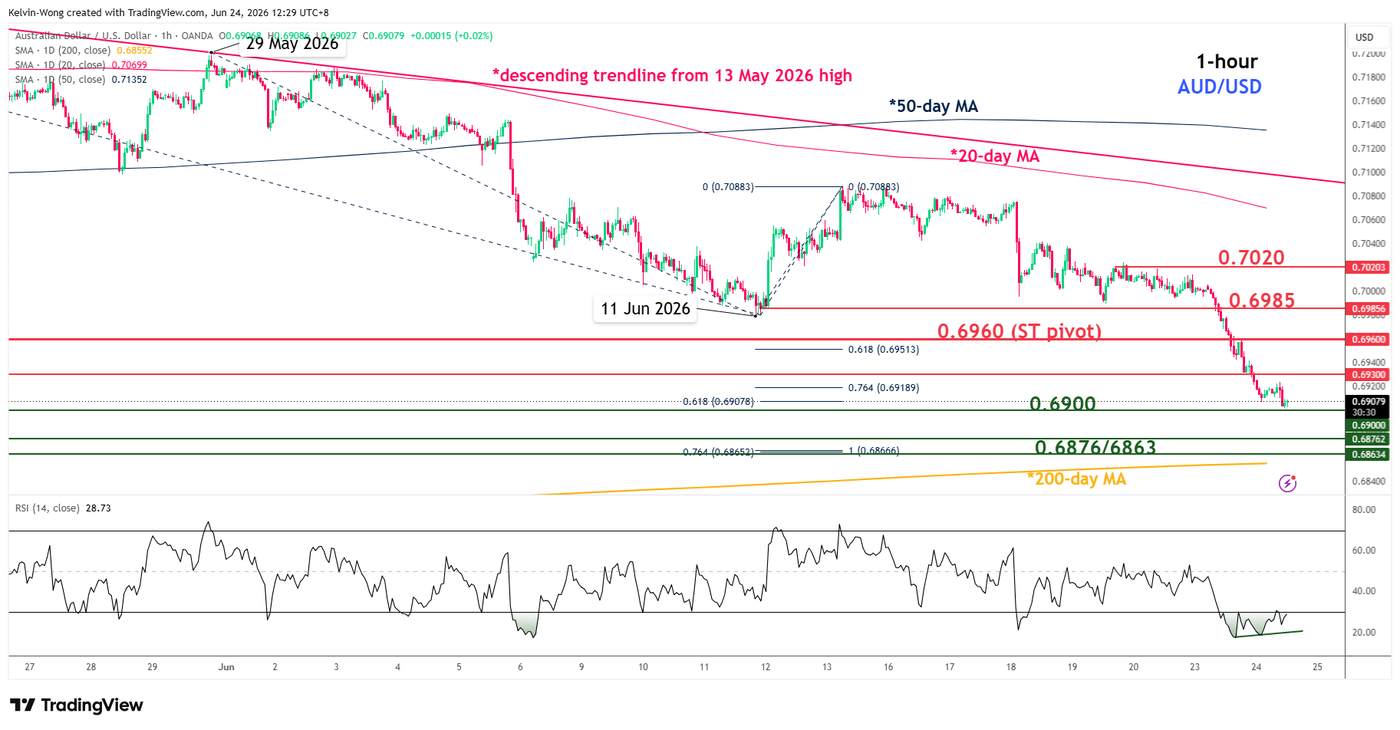
The AUD/USD has continued its medium-term downward spiral since the 13 May 2026 high of 0.7272 and extended its losses on Tuesday, 23 June by 1.2% to settle at a 2-month low of 0.6916 on the backdrop of rising risk aversion (see Fig. 1).
Tuesday’s steep intraday drop has led the hourly RSI momentum indicator to flash a bullish divergence in its oversold region, suggesting an imminent minor corrective/dead cat bounce.
Watch the 0.6960 key short-term pivotal resistance on the AUD/USD for the potential minor corrective rebound to get exhausted close to below it, with the next immediate supports coming in at 0.6900 and 0.6876/6863 (also close to the 200-day moving average).
On the other hand, a clearance and an hourly close above 0.6960 invalidates the bearish tone for an extension of the minor corrective rebound towards the next intermediate resistances at 0.6985 and 0.7020.
Top macro headlines
- Global tech selloff rattles Wall Street as valuation pressures broaden: The tech-heavy Nasdaq 100 plummeted 3.3 %, and the S&P 500 slipped 0.37% as investors aggressively locked in profits across semiconductor and hardware heavyweights, also dragged down by weakness in semiconductor-centric South Korea’s KOSPI (-10%). The widespread selloff reflected mounting institutional anxiety regarding the sustainability of elevated capital expenditure trends relative to intermediate-term AI monetisation timelines, forcing a broad risk-off rotation into defensive value stocks.
- Continuation of US Dollar Index positive follow-through after last week’s major range bullish breakout, cleared above 101.00: The greenback caught a ferocious safe-haven bid across global cash sessions, fracturing long-term technical and structural consolidation bands to hover near 101.40. The breakout was fueled by widening global interest-rate differentials, persistent core inflation revisions out of Europe, and broader defensive positioning amid systemic volatility in equities.
- Brent Crude sinks under $80 as operationalisation of Iranian waivers unwinds war premium: Front-month Brent crude oil futures extended losses by 1.5% to settle at $76.73/bbl on Tuesday, 23 June. The downward pressure accelerated as the US Treasury’s 60-day temporary export waivers for Iranian petroleum officially began shifting physical maritime flows, significantly alleviating immediate shipping anxieties in the Strait of Hormuz and triggering systematic trend-follower bearish liquidations.
Key macro themes
- The broadening valuation discipline across high-beta growth sectors: The simultaneous correction in megacap chip equities and public-market newcomer SpaceX (SPCX) signals an organic shift in institutional risk appetite. Rather than blindly funding continuous, open-ended capital expenditure pools, global asset allocators are beginning to demand clearer visibility on structural intermediate net income generation. With the cost of equity capital structurally elevated due to sticky short-end yields, growth multiples are encountering an organic compression phase, transitioning the macro environment away from pure thematic momentum toward strict balance-sheet discipline.
- The disruption of sovereign supply waves in short-duration fixed income: The upward repricing of the US 2-year Treasury yield demonstrates the compounding friction of sovereign debt expansion on the depth of institutional liquidity. As the US Treasury forces rolling multi-billion-dollar auctions onto primary dealers, market participants are extracting a structurally higher baseline term premium. This dynamic prevents long-duration yields from falling significantly, effectively introducing a persistent floor under global corporate borrowing costs and blunting the impact of any potential central bank policy easing cycles.
- Geopolitical risk escalation and commodity hedge liquidations: The swift operationalisation of the US-Iran 60-day implementation roadmap underscores the inherent fragility of geopolitical war premiums within the energy complex. Systematic macro funds and options desks that had built extensive long crude hedges are rapidly liquidating exposures as physical maritime telemetry confirms normalised merchant shipping flows through the critical Strait of Hormuz bottleneck. This injection of Persian Gulf oil supply is accelerating near-term energy cost deflation, offering localised breathing room to heavy energy-importing regions.
Global markets impact (last 24 hours)
Equities: The Nasdaq 100 plummeted 3.3% to close under pressure, while the S&P 500 slid 1.4% to finish at 7,365, closing below the 20-day moving average. The Dow Jones Industrial Average bucked the broader risk-off trend, closed almost unchanged on Tuesday, 23 June, supported by defensive health care stocks.
Fixed Income: Selling pressure dominated short-duration curves globally. The 2-year US Treasury yield remained firm at 4.2%, while the 10-year US Treasury yield traded above its 20-day moving average (4.49%) for the second consecutive session, settling at 4.50%.
FX: The US Dollar Index (DXY) staged an aggressive technical breakout past long-term range barriers amid risk aversion in global equities. The risk-sensitive Australian dollar dropped by 1.2%, hitting a 2-month low of 0.6916 against the greenback.
The British pound also wobbled, trading down 0.4% to settle at 1.3203 on Tuesday, looking to retest a 3-month low of 1.3160 amid waiting for clarity on the UK’s new Prime Minister’s policies. The Japanese yen continued to hover near the 161.95 multi-decade intervention threshold.
Commodities: Energy markets suffered extensive liquidation, with front-month Brent and WTI crude futures extending losses by 1.5% and 1.4% to settle at $76.73/bbl and $73.05/bbl on Tuesday, 23 June, while holding above their respective 200-day moving averages.
Spot gold continued its downward spiral, settling at $4,110/oz, just a whisker away from the 11 June 2026 low of $4,024/oz as surging sovereign bond yields and a dominant US dollar eroded its non-yielding appeal.
Asia Pacific impact
- South Korean and Taiwanese tech stocks bear the brunt of global liquidation: The global semiconductor rout sparked immediate downside tracking across APAC semiconductor stocks. South Korea’s KOSPI index suffered a dramatic 10% sell-off on Tuesday, 23 June, as foreign institutional capital flowed out of structural hardware leaders such as Samsung Electronics and SK Hynix. Intraday softness continued to prevail in today’s Asian session; Japan’s Nikkei 2225 (-1.6%), South Korea’s KOSPI (+0.5%), Taiwan’s TAIEX (-2.4%), Hong Kong’s Hang Seng Index (unchanged), China’s CSI 300 (+0.1%), Australia’s ASX 200 (+0.1%), and Singapore STI (+0.2%).
- Japanese yen tests policy-intervention boundary near 161.95: Wide real interest rate differentials continued to punish the Yen, locking USD/JPY below the critical 161.95 threshold. Despite increasingly stringent verbal warnings from Finance Minister Katayama regarding spot-market smoothing operations, macro funds are actively testing the central bank’s true pain threshold. Currently, the USD/JPY 161.55 intraday after Tuesday’s tight range movement of only 48 pips.
- Regional energy importers may capture input-cost windfalls: The collapse of Brent crude below $80/bbl is translating into an immediate structural current-account cushion for energy-dependent Asian economies such as China and India. The normalisation of Persian Gulf supply lowers immediate manufacturing input costs and insulates domestic trade balances from the rising US dollar.
Top 5 events to watch today
- RBA Deputy Governor Hauser Speech – 2.30 pm SGT Impact: AUD/USD, AUD crosses
- BoJ Deputy Governor Himino Speech – 2.40 pm SGT Impact: USD/JPY, JPY crosses
- Germany Ifo Business Climate (Jun) – 4:00 pm SGT (consensus: 85.6, May: 84.9) Impact: EUR/USD, EUR crosses, DAX
- EIA Weekly Crude Oil Stockpile Change – 10:30 pm SGT Impact: WTI crude oil futures
- Micron Technology FYQ3 Earnings (after US close) Impact: S&P 500, Nasdaq 100 E-mini futures
SOURCE LINK : Tech Selloff Deepens as US Dollar Strength Pressures Global Markets