Contents
In focus today
In Sweden, the focus is on the Riksbank minutes from last week’s meeting, released at 9.30 CET today. As this was a smaller meeting with no new projections and only a brief monetary policy update, the minutes will be important for understanding whether the relatively dovish communication was unanimously supported. The key questions as we see them are: 1) How close to a rate hike are Governor Thedéen and Seim, who have been the more hawkish members lately? 2) For the remaining three members, who form a majority (Jansson, Bunge and Hjelm), the question is whether any of them have moved any closer to Thedéen and Seim’s camp.
In the US, the Conference Board will release consumer confidence for August. The index showed 90.8 in July and has gradually trended down over the last years. Fed’s Barkin (non-voting member) will speak in the afternoon.
In the euro area, focus turns to the German Ifo indicator for August. The assessment of the current situation remains low, but expectations have risen lately and we expect a rebound in both components following the solid PMI report we received last week.
In Denmark, retail sales will be released for July. Our Spending Monitor showed a 0.3% m/m increase in real retail spending in July marking the third consecutive month with real increase in the retail spending. Over the past year the real retail spending has risen by 3.2%. We expect the figures from Statistics Denmark to reflect the same trend, with a modest increase in July.
Central Bank of Hungary will release its rate decision. We expect the central bank to cut rates by 25 bps to 5.50%.
Economic and market news
What happened overnight
In geopolitics, the US “economic D-Day” against Iran proved to be a limited market mover, as Treasury Secretary Scott Bessent mainly issued a broad warning of secondary sanctions against entities still doing business with Iran, without providing concrete details on timing, monitoring or the scope of enforcement. While the US aim is to further isolate Iran and “sever every economic lifeline”, the lack of specifics made the announcement feel more like a warning shot than a decisive escalation, leaving the immediate macro and market impact muted. Iran promised to retaliate against expanded US economic sanctions that the Americans said would cut off Iran’s economic lifeline, with Tehran expressing confidence that major trading partners like China would resist Washington’s pressure campaign.
What happened yesterday
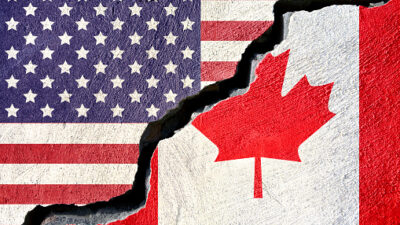
In US-Canada relations, US-Canada trade tensions have re-escalated after Trump announced plans to raise tariffs on Canadian cars and automotive parts to 50% from 1 January, following the collapse of negotiations. The dispute raises risks for the highly integrated North American auto supply chain and could weigh on investment. Trump wrote on his social media platform, that Canada no longer will be treated as a State.
Equities: Equities traded back and forth in a relatively quiet session, while implied volatility edged marginally higher. With little macro data to provide direction, the market remains caught between three dominant themes: oil and Iran, AI anxiety and the dollar debasement trade.
Yesterday, AI jitters were allowed to set the tone. Even with limited movement at the index level, Consumer Staples outperformed Technology by roughly 3 percentage points. This was not driven by positive consumer news. Instead, it tells us something important about the current stage of both the economic and investment cycles. Growth remains strong, but positioning is correspondingly opportunistic, with investors deeply underweight Staples. In the absence of competing macro catalysts, relatively little is therefore required to trigger substantial sector rotations. We are not necessarily arguing that yesterday’s move will persist, but the underlying market dynamics deserve attention.
We have recently seen an unusually high number of sessions in which cyclicals and defensives move in opposite absolute directions. On weaker equity days, defensives can rise even as the broader market falls, while on stronger days cyclicals lead and defensives frequently decline outright. This is not a conventional full risk-on or risk-off market. Investors are primarily rotating risk within equities rather than removing it altogether.
Asian equities are marginally lower this morning, which makes sense given the region’s exposure to yesterday’s Economic D Day announcements.
US and European futures are mixed, although the more tech heavy parts of the market are showing a modest positive bias.
FI and FX: US Treasuries bull-flattened yesterday, with the long end leading gains. The new sanctions campaign against Iran, announced yesterday, adds a new layer of geopolitical complexity to markets. Spot gas prices have now risen above the ECB’s adverse scenario, adding to the monetary policy uncertainty. EUR/USD has started the week edging marginally lower, now at 1.1650, whereas in Scandies we saw NOK/SEK break above 1.02 for the first time in almost three years.
SOURCE LINK : Riksbank Minutes to Shed Light on Board Divisions