
Three countries that mine 40.9% of the world’s silver each reported output short of plan this month, and not one of the reasons was a response to the silver price.
The reasons were a community blockade in Mexico, a zinc grade in Peru and a snowstorm in Chile. Three countries, three unrelated causes, and in none of them did the price of silver enter the decision. That is worth a closer look, because it points at who actually decides how much silver gets mined.
Silver trades at $68.70 this morning against gold at $4,587.10, a gold-silver ratio of 66.8. The metal is up roughly 77% on a year ago, though still about 44% below its January 29 intraday high. A price at these levels is the textbook trigger for a supply response. Golden Meadow® has been tracking whether one arrives, and this month gave three separate answers.
Contents
Mexico: A twelve-day blockade at a mine ten months old
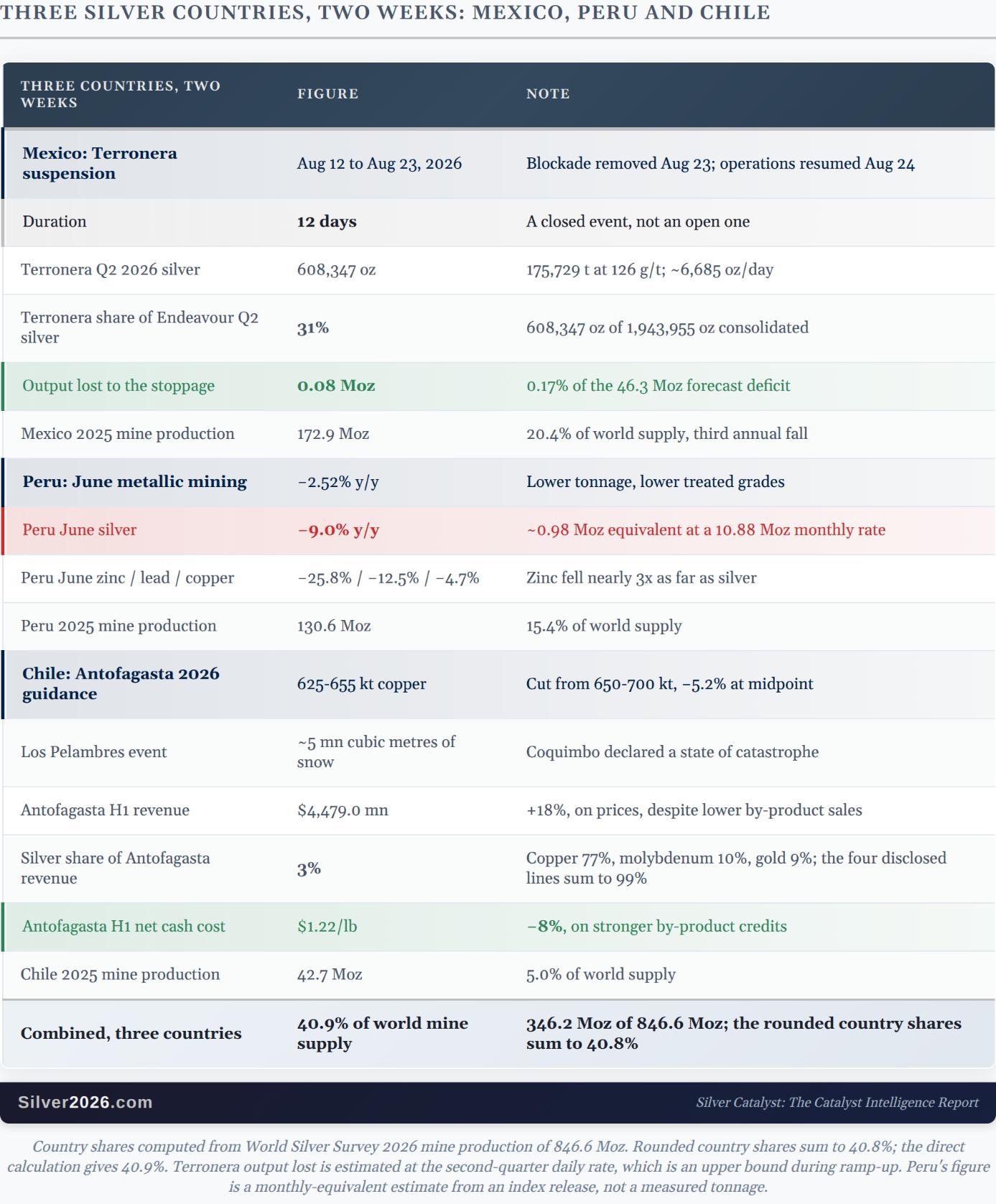
Endeavour Silver disclosed on August 16 that operations at Terronera in Jalisco had been suspended since August 12 by a blockade from members of the nearby Ejido community, with concerns recorded as road maintenance, assistance with medical services and communications, control of and access to water supply, and increased financial assistance. The blockade stayed peaceful throughout. A reduced workforce remained on site for safety and security, and the property stayed accessible for maintenance. On August 20 the company said negotiations were continuing in a cordial and respectful manner with no material change to operations. Three days later it announced the blockade had been removed, with operations resuming on August 24.
So this is now a closed event rather than an open one, which means the arithmetic can be actual rather than hypothetical. Twelve days of production were lost, from August 12 through August 23.
In the second quarter Terronera processed 175,729 tonnes of ore at 126 grams of silver per tonne and produced 608,347 ounces at a stated recovery of 85.4%. Those four figures reconcile: that tonnage at that grade contains 711,877 ounces, and the 608,347 ounces reported imply a recovery of 85.5%, against the 85.4% the company states. Across the 91 days of the quarter that is roughly 6,685 ounces a day, so twelve days comes to about 0.08 million ounces.
Two things pull that estimate in opposite directions. The mine is still ramping up, so the second-quarter rate is an upper bound on what it produces on an ordinary day. Against that, Endeavour told investors that Terronera’s silver grades were in line with plan and were expected to rise through the rest of the year as mining accesses higher-grade areas, which is the part of the year the blockade interrupted. The wider point is now settled rather than assumed: underground ore does not disappear because nobody can reach it for twelve days, and with the mine running again this was production deferred rather than supply removed.
The ounces are small. Which mine they belong to is not. Terronera achieved commercial production on October 1, 2025, less than a year ago, and in the second quarter it supplied 31% of Endeavour’s consolidated silver output. Mexico supplies 20.4% of world mine production at 172.9 million ounces in 2025 per Metals Focus and the Silver Institute, and that was a third consecutive annual decline. A mine ten months into production has had the least time to build a relationship with the community around it, though that cuts both ways and older Mexican operations have had disputes of their own run far longer than twelve days. Endeavour has not attributed the blockade to the silver price, and the concerns it records are infrastructure, health services, water and financial support.
Peru: The metal that fell was zinc
Peru’s statistics institute reported on August 15 that the metallic mining subsector contracted 2.52% in June against June 2025, with silver down 9.0%, zinc down 25.8%, lead down 12.5%, copper down 4.7% and gold down 1.1%. The institute attributed the result to lower tonnage extracted and to lower grades of the minerals treated at the concentrator plants, which is a polite way of saying the rock coming out of the ground carried less metal in it.
Look at the order of those declines. Zinc, the metal that governs the mine plan at most Peruvian polymetallic operations, fell nearly three times as far as silver did. Peru is the second-largest producing country at 130.6 million ounces, 15.4% of global mine supply, and most of that silver arrives as a companion to zinc, lead and copper rather than as the reason anyone dug the hole. Against Peru’s 2025 average monthly rate of 10.88 million ounces, a 9.0% decline is equivalent to roughly 0.98 million ounces. Treat that as a monthly-equivalent estimate rather than a measured June-to-June tonnage loss: the statistics institute publishes an index, while the energy and mines ministry publishes actual fine kilograms, and the ministry’s series is the one to wait for.
Chile: Five million cubic metres of snow
Antofagasta cut its 2026 copper guidance on August 13 to 625,000 to 655,000 tonnes from 650,000 to 700,000, a 5.2% reduction at the midpoint, after severe rain and snow forced an orderly shutdown at Los Pelambres and the Chilean government declared a state of catastrophe in the Coquimbo Region. The company says operations have resumed and are ramping, and that inspections identified the need for repairs to certain pipeline platforms and water management systems. On the results call management put the snowfall at around five million cubic metres and said the mine is currently working lower-grade zones, with higher-grade ore expected later this year or in early 2027. Silver appears nowhere in that reasoning. It simply arrives with less copper.
Antofagasta’s accounts show why it is unlikely to appear in that reasoning. Silver is 3% of group revenue against copper’s 77%, with molybdenum at 10% and gold at 9%. Half-year revenue rose 18% to $4,479.0 million, and the company attributes that to higher realised prices partially offset by lower sales in copper and by-products. Selling less and earning more is the whole story of a by-product metal. Where silver actually shows up in these accounts is on the cost line: net cash costs fell 8% to $1.22 a pound following stronger by-product credits, meaning the rising silver and gold prices are subtracted from the cost of producing copper. A metal that is 3% of the revenue and a credit against somebody else’s costs does not get a vote on how much of it gets mined.
Sources: GlobeNewswire: Endeavour Silver Announces Removal of Blockade at Terronera | StockTitan: Endeavour Silver Q2 2026 Form 6-K and MD&A | INEI via PQS: National Production Report, June 2026 | Antofagasta: 2026 Half Year Results | Metals Focus and the Silver Institute: Silver Supply and Demand
What this means to Silver investors
For the price, this is mildly supportive over one to three years. For anyone who still expects supply to answer price, it is the opposite.
Roughly three quarters of the world’s silver now comes from mines dug primarily for copper, lead, zinc or gold, which is the starting point of the supply argument in Silver Rising. The World Silver Survey 2026, produced by Metals Focus and the Silver Institute, records that the percentage of global supply from primary silver mines fell to a new low of 26% in 2025, with non-primary output reaching 625.5 million ounces. Those mines live and die on the economics of everything else in the orebody.
The combined effect of this month’s three events is about 1.1 million ounces, being 0.98 million ounces of monthly-equivalent Peruvian output and 0.08 million ounces at Terronera, against the 46.3 million ounce deficit Metals Focus and the Silver Institute forecast for 2026, which would be the sixth consecutive year of shortfall, five complete and this one a forecast. That is 2.3% of the shortfall, and the Mexican part of it is deferred rather than lost. It is not a market-moving quantity on any reading.
The mechanism is the point. A community stoppage, a national statistics release and one company’s cost line, from three countries and three unrelated causes, all pointing the same way: when the silver price rises, it reaches the revenue line of companies that were not mining silver for its own sake, and it reaches the cost line of companies mining something else entirely. What it does not reach is the decision about how much rock to move. That is why mine supply is forecast at 844.1 million ounces this year against 846.6 million ounces last year, essentially flat, in a year when the metal has traded well above the $40.03 it averaged in 2025 per Metals Focus and the Silver Institute. For a holder, an inelastic supply base is the structural half of the longer-term case. For anyone waiting on producers to solve the shortage, this month was three separate reminders that the silver price is not the number they are managing to.
SOURCE LINK : What cut silver output in Mexico, Peru and Chile at once?