Our summary of recent economic events and what to expect in the weeks ahead.
Contents
Canadian Highlights
- Real GDP grew at its fastest pace since 2023 in the second quarter, rising 3.3%. Growth was driven by strong goods exports, a rebound in business investment and solid household spending.
- However, new U.S. tariffs could have a moderate impact on Canadian GDP growth over the next year, while Canada’s reciprocal tariffs could have only a marginal impact on growth but add modestly to inflation.
- Amid renewed trade tensions, foreign demand for Canadian portfolio assets remains strong – a good sign for a country looking to spur an investment supercycle.
U.S. Highlights
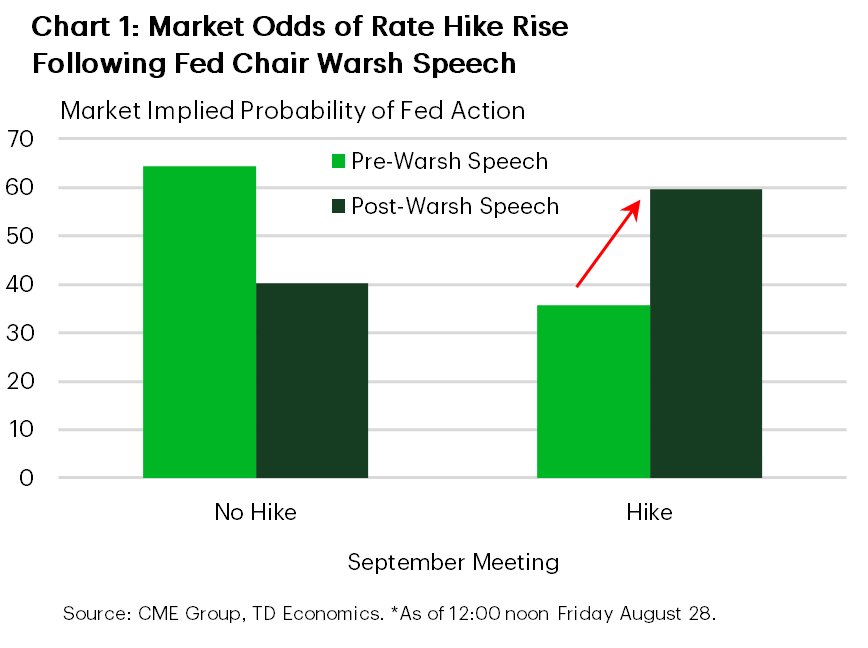
- In his Jackson Hole keynote, Fed Chair Kevin Warsh delivered a hawkish assessment, prompting market odds to shift firmly toward a near-term rate hike.
- The second estimate of Q2 GDP left headline growth unchanged at 1.5% annualized, but revised growth in real final sales to private domestic purchasers up moderately to a strong 4.2%.
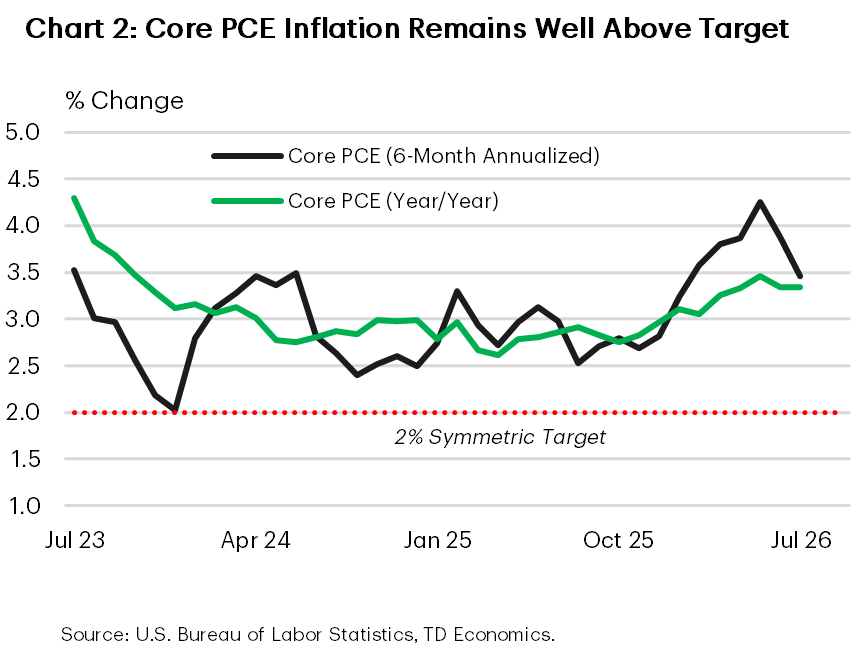
- July’s PCE report offered little evidence of renewed disinflation, with core inflation remaining well above the Federal Reserve’s 2% target.
Canada Is Standing Strong Amid Renewed Trade Conflict
There was plenty of news for markets to digest this week. Early in the week, all eyes were on the collapse of Canada-U.S. trade negotiations. On Friday, the S&P/TSX Composite initially rallied on the fastest pace of GDP growth since 2023, before losing steam following Fed Chairman Warsh’s speech. The loonie also reacted, trading weaker.
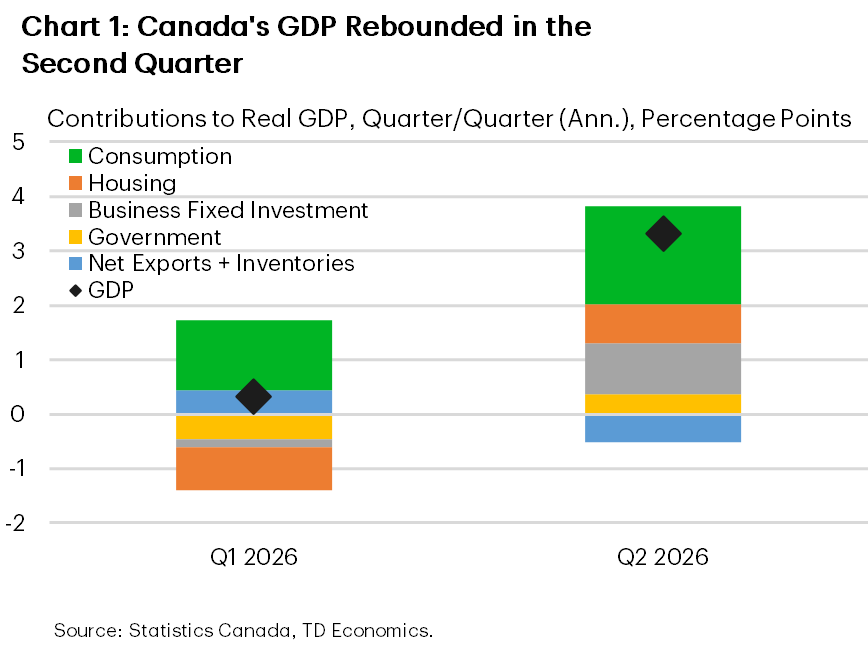
First the good news. Real GDP rose a healthy 3.3% quarter-on-quarter annualized in Q2 2026, partly reflecting a reversal of the temporary weakness in Q1. On a per capita basis, real GDP increased by 1.0%, as the population declined for a third consecutive quarter. Looking through quarterly volatility, Canada’s economy grew 1.8% in the first half of the year.
Strong goods exports, a rebound in business investment and household spending propelled growth, with rising imports and declining inventories only partially offsetting the gains (Chart 1). Business investment finally rebounded after two quarters of declines, supported by spending on engineering structures and machinery and equipment. Household spending accelerated in Q2 after an already strong Q1 pace, while the sizeable increase in goods exports was led by cars, metals and energy products, and industrial machinery and equipment.
The rebound in trade in the second quarter is cold comfort now that Canada’s trade relationship with the U.S. has soured. After Canada suspended trade negotiations, 50% U.S. tariffs on roughly $20 billion of Canadian goods came into effect on Saturday. Canada has announced its own counter tariffs set to come into effect after Labour Day. We estimate the new U.S. tariffs could shave 0.3–0.6 percentage points (ppts) from Canadian GDP growth over the next year. Canada’s counter-tariffs should have only a marginal impact on growth but could lift CPI inflation by 0.1–0.3 ppts year-on-year. Harder to quantify is the cost of a bad deal. And even an agreement would not have fully eliminated trade risks, given the White House’s willingness to threaten new tariffs on countries with whom it has already struck deals.
Whether negotiations can resume soon is uncertain. In the meantime, Canada has focused on new opportunities and partnerships. Creating a competitive environment that unlocks an investment supercycle would help: more than $1 trillion in announced projects are on the table through 2035 and beyond, with the potential to create rolling waves of investment.
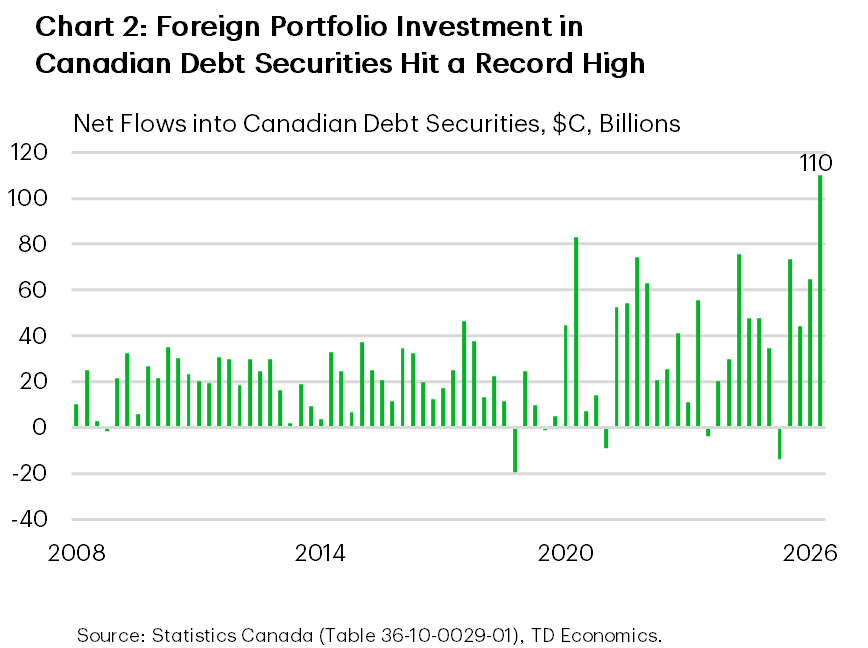
That outcome requires bold policy action. If successful, it could reduce the need for public funding by creating a stronger ecosystem for private investment. Judging by Q2 financial accounts, there is still work to be done to attract more long-term direct investment from abroad. But foreign demand for Canadian portfolio assets is already strong and increasingly coming from outside the U.S. A record $110 billion flowed into Canadian debt securities in Q2 2026 (Chart 2) – a good sign that foreign investors are willing to provide capital at a time when Canadian governments and corporations need it most. The capital is flowing. Now Canada needs to put it to work.
U.S. – A Hawkish Assessment, Still No Forward Guidance
U.S. markets spent the week balancing resilient demand against persistent inflation and renewed trade frictions. The main event, however, was Fed Chair Warsh’s Friday keynote at Jackson Hole. While offering little meeting-specific guidance, he delivered a hawkish assessment that underlying inflation remains too high, pushing short-term Treasury yields and the trade-weighted U.S. dollar higher, while equities also posted modest gains.
Warsh outlined a principles-based approach to monetary policy and argued that forward guidance had “overstayed its welcome.” The Fed, in his view, should explain its objectives and framework without pre-committing to a rate path or encouraging investors to trade on policymakers’ signals. Structural changes, including artificial intelligence and greater competition for global savings, also require the Fed to reconsider assumptions formed during the previous low-rate era.
On the outlook, Warsh described the labor market as consistent with full employment but inflation as more concerning. Recent readings had not convinced him that underlying trends had improved meaningfully, and he was “hard pressed to describe broad financial conditions as restrictive.” While stopping short of explicitly endorsing a near-term hike, he warned the Fed has “work to do” if inflation does not move sufficiently toward target. He was committing to “a discipline, not to a decision.” Market pricing following the speech shifted firmly toward a near-term rate hike (Chart 1).
Other releases continued to point to a resilient economy. The second estimate of Q2 GDP left growth unchanged at 1.5% annualized, but stronger details pointed to solid underlying demand. Real final sales to private domestic purchasers were revised up moderately to 4.2%. On payrolls, a preliminary benchmark revision placed the March 2026 payroll level 79,000 below the current estimate, a modest adjustment that leaves the labour-market picture relatively intact.
July’s income and spending report showed decent consumer momentum despite a soft month. Real spending was unchanged in July, but the three-month annualized trend is running at a healthy 3.3%, consistent with consumer spending of 2.5% in Q3. More importantly for the Fed, core PCE inflation remained well above target, offering little evidence of renewed disinflation (Chart 2).
Warsh’s task is complicated by forces outside the Fed. Treasury’s expanded purchases of longer-dated debt could lower borrowing costs working against monetary restraint. Trade tensions pose another inflation risk. The U.S. imposed 50% tariffs on $20 billion of Canadian goods, including USMCA-compliant products, while Canada announced matching countermeasures effective September 8. The direct effect should remain manageable at the current scale, but further escalation remains a risk.
The bottom line is that Warsh provided little guidance on timing but a clearer, hawkish policy bias. With growth resilient, a lot is riding on the August CPI report to show progress on underlying inflation and keep the Fed on the sidelines.
SOURCE LINK : The Weekly Bottom Line: A Hawkish Assessment, Still No Forward Guidance