- BoJ expected to lift rates to 1.0% amid energy crisis.
- But will it be a hawkish enough hike to offer the yen a lifeline?
- Government subsidies skew inflation data but wage growth accelerates.
- Intervention risks remain high ahead of Tuesday’s decision.
Contents
Policy Rate to Rise to 31-Year High
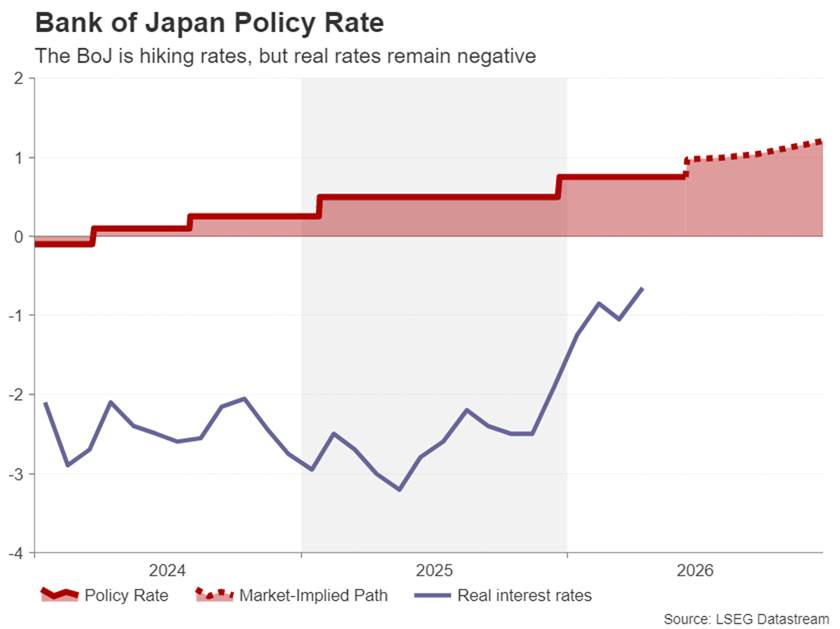
The Bank of Japan is poised to hike interest rates for the fifth time in this tightening cycle on Tuesday, taking the policy rate from 0.75% to 1.00%. As has become customary for BoJ rate hikes lately, the hawkish rhetoric has been intensifying in the run up to the meeting, with Governor Ueda essentially locking in the move in his last appearance on June 3.
Yet, markets have only priced in around a 90% probability for a 25-bps hike next week, as persistent doubts about the BoJ’s commitment to policy normalization continue to dog the rate outlook, and in turn, the yen. Policymakers have been getting itchy about second-round effects of inflation, as energy prices remain elevated amid the ongoing blockade of the Strait of Hormuz.
Price Pressures Are Growing Despite CPI Fall
The longer oil and gas flows through the crucial Middle East shipping lane stay at a trickle of pre-war levels, the greater the risk that higher energy prices will spill over onto other sectors of the economy.
However, inflation for now appears to be heading lower, mainly due to government support measures to help households with the cost-of-living crisis. Fuel and education subsidies pushed both headline and core CPI down to 1.4% y/y in April, while the Takaichi government has announced a new fiscal package to lower energy bills from July to September.
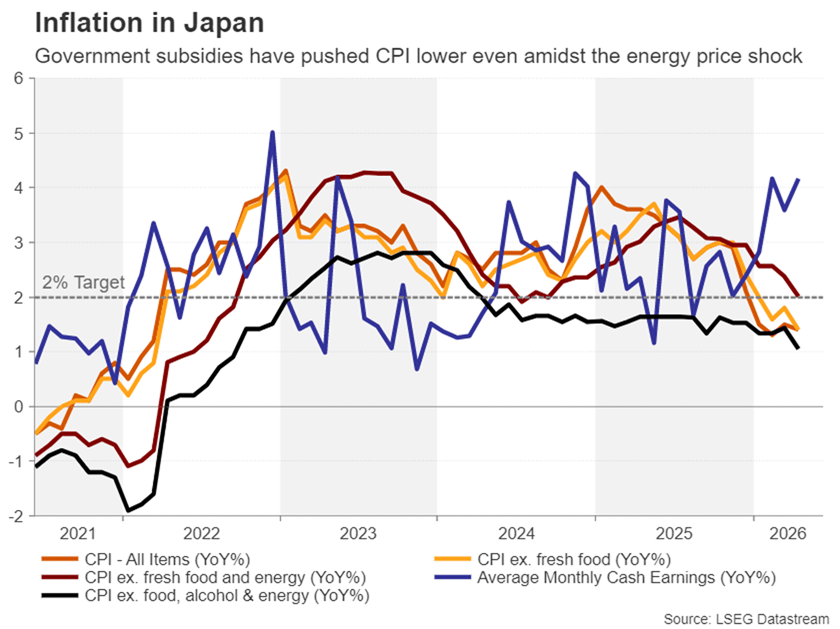
Under the hood, however, price pressures are brewing. Wage growth has exceeded 3.0% – a level seen as crucial by the BoJ for sustainably meeting its 2% inflation target – for most of 2026. Producer prices have also accelerated sharply in recent months, as the weaker yen has exacerbated higher import costs on top of the surging oil prices.
The BoJ’s Complicated Path
More importantly, despite the series of rate hikes since March 2024, real interest rates in Japan remain negative, meaning monetary policy is still highly accommodative. The Bank of Japan has been eager to point this out to signal it has plenty of scope to continue raising rates. Yet, there is a real risk the Bank of Japan has already fallen too far behind the curve and it should tighten policy at a much faster pace.
The election of Prime Minister Sanae Takaichi has added to the controversy for policymakers to proceed more hawkishly, as the new government has been vocal about being opposed to higher interest rates.
So where does all this leave the yen? The beleaguered Japanese currency has been under constant selling pressure since Takaichi came into power. The energy crisis has further cast doubt on rate hike bets on expectations that the BoJ will prioritize growth over inflation whilst the Middle East turmoil unfolds.
Yields Surge, but Yen Flounders
In contrast, long-term Japanese government borrowing costs have soared. The 10-year yield is at near 30-decade highs and the 30-year yield at historic highs. But concerns about Japan’s mounting national debt have been a bigger driver than inflation, hence, the boost to the yen has been limited.
However, even as the BoJ is likely to raise rates by a further 25 bps on Tuesday, not much is expected to change in its stance. Unless policymakers are in a position to signal a shift to more aggressive tightening, the yen will continue to struggle.
Yen Reaction in Ueda’s Deputy’s Hands
Following his sudden hospitalization, Governor Kazuo Ueda will not attend the June 16 meeting, which will now be chaired by Deputy Governor Ryozo Himino, while the press conference will be conducted by his other deputy, Shinichi Uchida.
Either way, whoever appears at the podium will have to pick his words carefully, as the slightest disappointment could trigger fresh selling in the yen. With the 160-level already being tested, a not-so-hawkish outcome could propel the US dollar towards 162 yen.
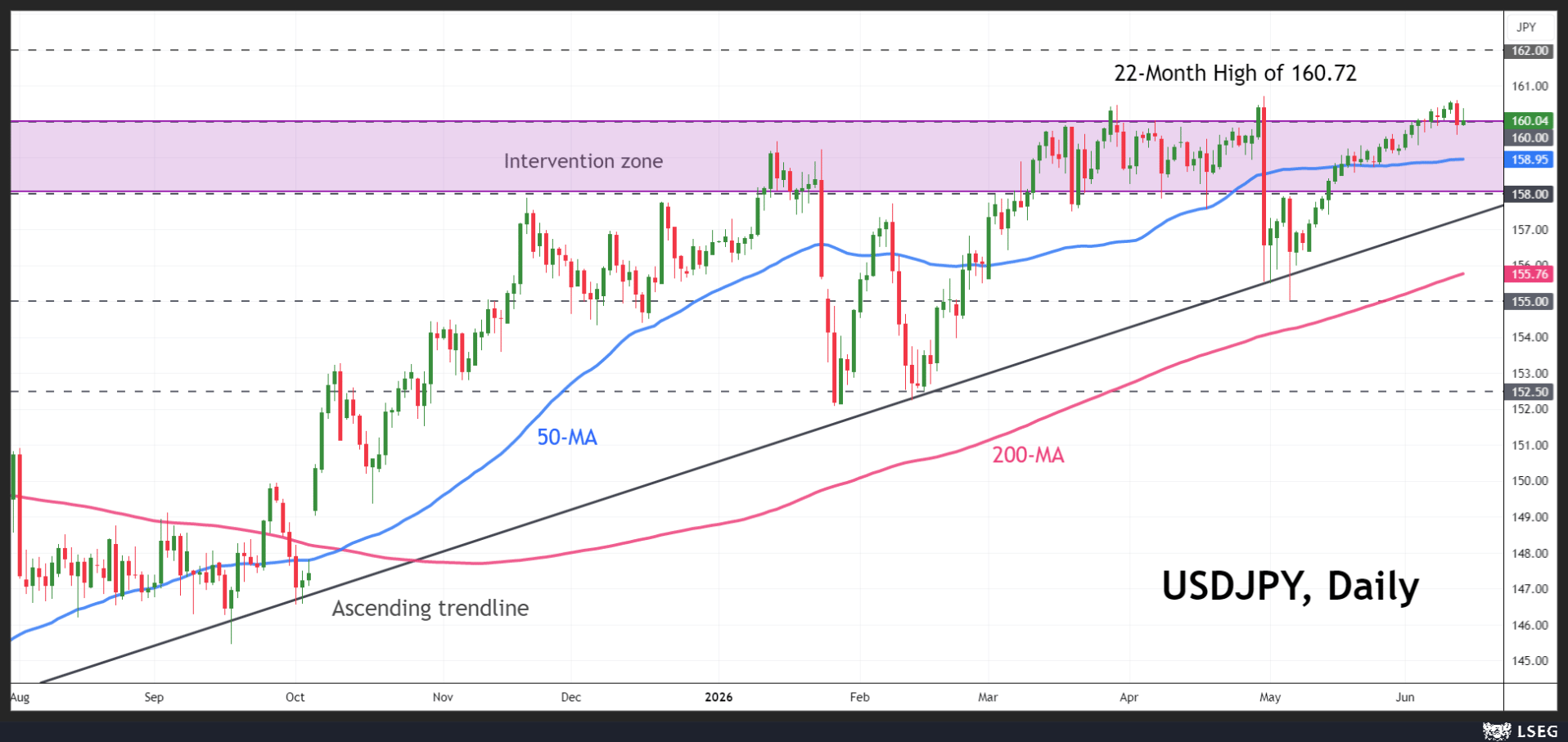
However, a surprisingly hawkish tone by Uchida would likely cause only minor damage to dollar bulls, with any drop struggling to extend beyond the ascending trendline in the absence of government intervention. But in the event a dollar spike forces the government to step in, the 155 level would be the initial target for yen bulls, followed by the 152.50 area.
The risk for traders is that any intervention may not come until the following day when the Federal Reserve announces its decision for US rates. Even if the BoJ manages to draw a line under the yen’s recent losses, it could all come undone should the Fed take a hawkish turn on Wednesday by removing its easing bias.
SOURCE LINK : BoJ Set to Hike, but Will It Save the Yen?