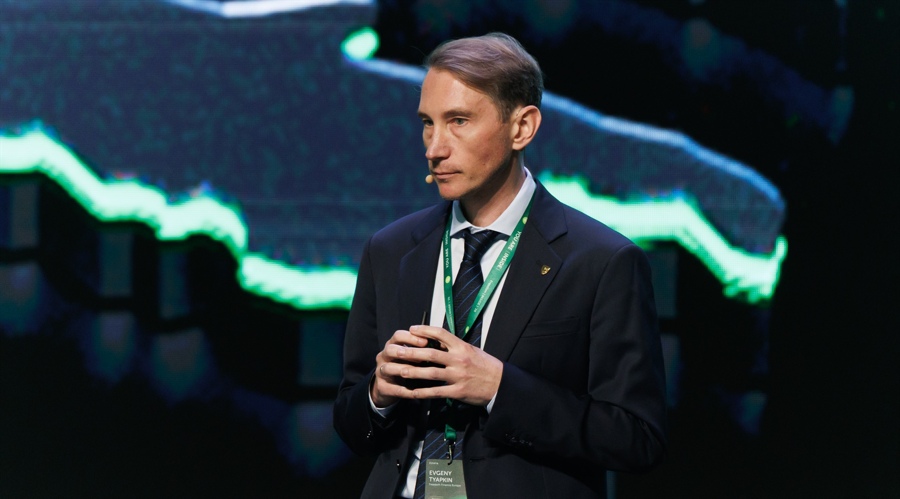
Evgenii Tiapkin, Executive Director of Freedom24, on Neo Compliance, the systems underpinning trust in financial services, and why building a financial ecosystem in Europe requires more than product ambition.
Evgenii Tiapkin has led Freedom24’s European business for over a decade, overseeing its transformation from a fast-growing online brokerage into a platform serving more than 600,000 clients across all EU/EEA states.
Freedom24 operates under Freedom Holding Corp. (NASDAQ: FRHC), a publicly listed financial services and technology group active across the United States, Europe, the Middle East, and Central Asia. Beyond brokerage, the wider Freedom ecosystem includes proprietary technology platforms, AI-powered solutions, and the Freedom SuperApp, one of the most comprehensive digital ecosystems currently operating in Central Asia.
Tiapkin sat down with Finance Magnates to discuss how Freedom24 is evolving in Europe, what a true financial ecosystem is, and why compliance infrastructure has become one of the industry’s most important competitive advantages.
Contents
- 1 Freedom24 is often perceived as a fintech, but at its core you’re still a brokerage. How do you define the business today, particularly given your recent announcement that you’re exploring a banking licence?
- 2 Much of the discussion around Freedom globally today centres on the SuperApp you have in Kazakhstan. What exactly is it?
- 3 Why do you think Europe has not yet produced a true SuperApp model? What would need to happen for Freedom to start rolling this model out?
- 4 Freedom24 owns its technology entirely. In an era of abundant infrastructure-as-a-service, why does that choice matter?
- 5 As financial groups scale across markets, what tends to become the biggest operational bottleneck that most people underestimate?
- 6 As AI becomes more embedded in client-facing financial services, like the Neo Compliance, how do you define what should be handled by machines versus humans?
- 7 Looking at the trajectory of European retail finance, where do you see the most significant structural shift underway, and where does Freedom24 sit in relation to it?
- 8 ABOUT FREEDOM24
- 9 Freedom24 is often perceived as a fintech, but at its core you’re still a brokerage. How do you define the business today, particularly given your recent announcement that you’re exploring a banking licence?
- 10 Much of the discussion around Freedom globally today centres on the SuperApp you have in Kazakhstan. What exactly is it?
- 11 Why do you think Europe has not yet produced a true SuperApp model? What would need to happen for Freedom to start rolling this model out?
- 12 Freedom24 owns its technology entirely. In an era of abundant infrastructure-as-a-service, why does that choice matter?
- 13 As financial groups scale across markets, what tends to become the biggest operational bottleneck that most people underestimate?
- 14 As AI becomes more embedded in client-facing financial services, like the Neo Compliance, how do you define what should be handled by machines versus humans?
- 15 Looking at the trajectory of European retail finance, where do you see the most significant structural shift underway, and where does Freedom24 sit in relation to it?
- 16 ABOUT FREEDOM24
Freedom24 is often perceived as a fintech, but at its core you’re still a brokerage. How do you define the business today, particularly given your recent announcement that you’re exploring a banking licence?
Today, brokerage remains the foundation of our business in Europe. We provide more than 600,000 retail investors with access to global markets through our own proprietary platform, Tradernet, developed fully in-house. That is our core business and it continues to grow.
The difference is that we don’t see ourselves as a neobroker focused solely on low-cost execution, nor as a traditional brokerage dependent on legacy infrastructure. We combine the regulatory standards and market access of a traditional broker with a modern digital experience. You can call it a digital-first model, though we still maintain a physical presence across many markets, with teams deployed to serve a range of client needs, from customer support to investment advisory.
Our goal is to make financial and broader digital services more accessible and comfortable, but not substitute decision-making. Here, digital reach and local depth address different things. We can service clients all across Europe, but servicing rights do not tell us anything about how investors in different markets think and what they look for, and this ultimately shapes trust towards the brand. Physical offices with local teams are there to close these gaps. They are also a signal of commitment, particularly in markets with strong legacy institutions, where financial trust is highly relationship-driven. We do not move into a market until the operational and compliance infrastructure is ready to serve it at the standard we hold ourselves to elsewhere.
I’d say this philosophy makes us a neo-traditional broker. At the same time, brokerage as a model has clear structural limits in terms of how far you can integrate adjacent services without changing the underlying infrastructure and regulatory perimeter.
Much of the discussion around Freedom globally today centres on the SuperApp you have in Kazakhstan. What exactly is it?
The simplest way to think about the Freedom SuperApp is as a unified digital ecosystem that brings together financial and everyday services within a single platform. Through one application and one account, users can access banking, payments, investing, insurance, government services, travel bookings, ticketing and a growing range of lifestyle services.
What makes the model compelling is not any individual feature, but the way these services work together. Traditionally, consumers manage different aspects of their financial and daily lives across multiple providers and platforms. The SuperApp removes much of that friction by creating a seamless experience built on shared infrastructure, a single customer relationship and integrated data flows.
The result is greater convenience for users and deeper engagement across the ecosystem. Today, more than 5.5 million clients in Central Asia use the Freedom SuperApp, with that customer base built in less than two years. We see it as a practical example of how financial services, commerce and digital platforms are increasingly converging into a single customer experience. Ultimately, the SuperApp is not a product but a distribution and engagement platform that allows us to serve a much broader share of our customers’ financial and everyday needs.
Why do you think Europe has not yet produced a true SuperApp model? What would need to happen for Freedom to start rolling this model out?
Europe is one of the world’s most advanced financial markets, but it is also one of the most fragmented. Banking, investing, insurance, payments and lifestyle services have largely developed as separate industries, with different regulatory frameworks, technology stacks and customer journeys. That has produced many excellent specialist providers, but relatively few integrated platforms. As a result, most European fintech success stories tend to focus on a single vertical. What remains relatively rare is a business that brings all of those capabilities together within one ecosystem and one customer experience.
We believe that creates a significant opportunity. The model we have built in Central Asia demonstrates that customers increasingly value simplicity, convenience and seamless access to services that were traditionally delivered through separate providers. The challenge is no longer technological; it is creating the right operational foundations and trust to support that level of integration.
That is one of the reasons we are now actively exploring the possibility of obtaining a banking licence in Europe. Banking is a critical infrastructure layer. A broker may be part of a customer’s investment journey, but a bank typically sits at the centre of a customer’s daily financial life. Once that foundation is in place, it becomes possible to integrate a broader range of services into a single environment.
Importantly, our ambition is not to build another neobank. We are focused on creating a broader financial and lifestyle ecosystem in which banking is an entry point rather than the final product. The objective is to give customers a more connected experience across the services they use every day, rather than asking them to manage those relationships across multiple platforms.
Freedom24 owns its technology entirely. In an era of abundant infrastructure-as-a-service, why does that choice matter?
Owning our core technology determines both the ceiling of what we can build and the speed at which we can build it. When you rely on third-party infrastructure, you inevitably inherit its constraints — from product roadmaps and data architecture to security models and integration limits. That is manageable if you are operating a single-product business but becomes much more complex when you are building a comprehensive digital services platform across multiple jurisdictions.
Full ownership allows us to design that stack end-to-end. It means we control the architecture, the data model and the integration logic, rather than adapting to external systems. Just as importantly, it allows us to iterate quickly and consistently across all layers of the platform.
The scale of efficiency gains that technology can unlock in our work is paramount. Of course, not everything should be internalised and we may outsource some operational functions. But core technology is different, that is something we deliberately keep in-house, because a digital broker — and even more so a full ecosystem — is fundamentally a technology company.
Ultimately, the most important assets we have are not individual products, but the technology we build and the talent that builds it. That is what determines our ability to scale, adapt, and compete across markets.
As financial groups scale across markets, what tends to become the biggest operational bottleneck that most people underestimate?
In my experience, the real bottlenecks appear in the operational layer that sits underneath growth as these functions do not scale linearly. Just one example would be the compliance function. As you expand, the volume of documentation, verification requirements, transaction monitoring and reporting grows exponentially, while traditional operating models are still built around manual review and incremental hiring. That creates a structural constraint on growth.
We have seen this across multiple areas of the business, from onboarding workflows to risk monitoring and compliance operations. One clear example is how we approached compliance itself. Instead of treating it as a manual control function that expands with headcount, we re-architected it as an AI-driven system of specialized agents. That system — which we refer to internally as an Neo Compliance — is now capable of processing source-of-funds documentation from more than 80 countries in minutes rather than tens of minutes, performing forensic verification at scale, and running transaction monitoring across the entire client base in near real time. Importantly, it is designed as a human-in-the-loop model, where AI does the analytical heavy lifting and compliance officers retain full decision authority.
The same pattern exists in other parts of the business — whether it is onboarding, payments infrastructure, or credit decisioning. Anywhere you have high-volume financial workflows, the question becomes the same: how do you prevent operational complexity from scaling faster than the business itself? That is ultimately where the real constraint in financial services lies, and why we focus so heavily on building technology that allows operational capacity to scale with demand rather than lag behind it.
As AI becomes more embedded in client-facing financial services, like the Neo Compliance, how do you define what should be handled by machines versus humans?
The distinction is not defined by what AI is technically capable of doing, but by the nature of the consequence attached to the decision. AI is most effective in areas where the impact of a marginal error is limited, but the value of scale, speed and accessibility is high. In a client-facing environment, that includes helping users understand their portfolio, providing market context, navigating the platform, or answering procedural questions across multiple languages. These are interactions where immediacy and usability matter more than deliberative judgment.
As soon as decisions carry regulatory, fiduciary or materially irreversible consequences, the logic changes. In those cases, human judgment must remain central. Not because AI cannot process the information, but because accountability, interpretability and responsibility cannot be delegated to a system.
The goal is therefore not to separate AI and humans by task type, but by level of consequence. AI can and should handle the high-volume, low-risk cognitive load that slows down both clients and internal teams. Humans should focus on the decisions where context, experience and accountability are essential. This is why we design our systems around a human-in-the-loop principle rather than full automation. It ensures that AI improves responsiveness and efficiency at the surface layer of the client experience, while preserving human authority wherever outcomes meaningfully affect risk, regulation or client capital.
Ultimately, the question is not what AI can do, but what it should decide. And that line is drawn by responsibility, not capability.
Looking at the trajectory of European retail finance, where do you see the most significant structural shift underway, and where does Freedom24 sit in relation to it?
The most consequential shift is the gradual dissolution of the boundary between financial services categories. Brokerage, banking, insurance and financial planning have historically been delivered by separate institutions operating under distinct regulatory frameworks. That separation made sense when distribution was physical and switching costs were high. In an increasingly digital environment, clients have less incentive to navigate those boundaries.
The platforms that will define European finance are those able to integrate across these categories without compromising regulatory integrity. That is a demanding standard to meet, and it remains unclear how many players will be able to execute on it at scale, which is why relatively few have attempted it seriously. Incumbents still benefit from balance sheet strength and entrenched customer trust — advantages that cannot be replicated through convenience alone, which is why trust sits alongside technology in our model.
Achieving this requires strong technology, a multi-layered regulatory framework, and the operational discipline to scale both together. At Freedom, we have been building that combination for the better part of a decade, and we continue to evolve as the market structure changes.
ABOUT FREEDOM24
Freedom24 is the European subsidiary of Freedom Holding Corp. (Nasdaq: FRHC), an international financial group active across the United States, Europe, Central Asia and the Middle East. Licensed by CySEC and operating under the MiFID II framework, Freedom24 provides retail investors in all EU/EEA states with access to global markets through a fully proprietary platform. The company has physical offices in ten European countries and serves over 600,000 clients.
Evgenii Tiapkin, Executive Director of Freedom24, on Neo Compliance, the systems underpinning trust in financial services, and why building a financial ecosystem in Europe requires more than product ambition.
Evgenii Tiapkin has led Freedom24’s European business for over a decade, overseeing its transformation from a fast-growing online brokerage into a platform serving more than 600,000 clients across all EU/EEA states.
Freedom24 operates under Freedom Holding Corp. (NASDAQ: FRHC), a publicly listed financial services and technology group active across the United States, Europe, the Middle East, and Central Asia. Beyond brokerage, the wider Freedom ecosystem includes proprietary technology platforms, AI-powered solutions, and the Freedom SuperApp, one of the most comprehensive digital ecosystems currently operating in Central Asia.
Tiapkin sat down with Finance Magnates to discuss how Freedom24 is evolving in Europe, what a true financial ecosystem is, and why compliance infrastructure has become one of the industry’s most important competitive advantages.
Freedom24 is often perceived as a fintech, but at its core you’re still a brokerage. How do you define the business today, particularly given your recent announcement that you’re exploring a banking licence?
Today, brokerage remains the foundation of our business in Europe. We provide more than 600,000 retail investors with access to global markets through our own proprietary platform, Tradernet, developed fully in-house. That is our core business and it continues to grow.
The difference is that we don’t see ourselves as a neobroker focused solely on low-cost execution, nor as a traditional brokerage dependent on legacy infrastructure. We combine the regulatory standards and market access of a traditional broker with a modern digital experience. You can call it a digital-first model, though we still maintain a physical presence across many markets, with teams deployed to serve a range of client needs, from customer support to investment advisory.
Our goal is to make financial and broader digital services more accessible and comfortable, but not substitute decision-making. Here, digital reach and local depth address different things. We can service clients all across Europe, but servicing rights do not tell us anything about how investors in different markets think and what they look for, and this ultimately shapes trust towards the brand. Physical offices with local teams are there to close these gaps. They are also a signal of commitment, particularly in markets with strong legacy institutions, where financial trust is highly relationship-driven. We do not move into a market until the operational and compliance infrastructure is ready to serve it at the standard we hold ourselves to elsewhere.
I’d say this philosophy makes us a neo-traditional broker. At the same time, brokerage as a model has clear structural limits in terms of how far you can integrate adjacent services without changing the underlying infrastructure and regulatory perimeter.
Much of the discussion around Freedom globally today centres on the SuperApp you have in Kazakhstan. What exactly is it?
The simplest way to think about the Freedom SuperApp is as a unified digital ecosystem that brings together financial and everyday services within a single platform. Through one application and one account, users can access banking, payments, investing, insurance, government services, travel bookings, ticketing and a growing range of lifestyle services.
What makes the model compelling is not any individual feature, but the way these services work together. Traditionally, consumers manage different aspects of their financial and daily lives across multiple providers and platforms. The SuperApp removes much of that friction by creating a seamless experience built on shared infrastructure, a single customer relationship and integrated data flows.
The result is greater convenience for users and deeper engagement across the ecosystem. Today, more than 5.5 million clients in Central Asia use the Freedom SuperApp, with that customer base built in less than two years. We see it as a practical example of how financial services, commerce and digital platforms are increasingly converging into a single customer experience. Ultimately, the SuperApp is not a product but a distribution and engagement platform that allows us to serve a much broader share of our customers’ financial and everyday needs.
Why do you think Europe has not yet produced a true SuperApp model? What would need to happen for Freedom to start rolling this model out?
Europe is one of the world’s most advanced financial markets, but it is also one of the most fragmented. Banking, investing, insurance, payments and lifestyle services have largely developed as separate industries, with different regulatory frameworks, technology stacks and customer journeys. That has produced many excellent specialist providers, but relatively few integrated platforms. As a result, most European fintech success stories tend to focus on a single vertical. What remains relatively rare is a business that brings all of those capabilities together within one ecosystem and one customer experience.
We believe that creates a significant opportunity. The model we have built in Central Asia demonstrates that customers increasingly value simplicity, convenience and seamless access to services that were traditionally delivered through separate providers. The challenge is no longer technological; it is creating the right operational foundations and trust to support that level of integration.
That is one of the reasons we are now actively exploring the possibility of obtaining a banking licence in Europe. Banking is a critical infrastructure layer. A broker may be part of a customer’s investment journey, but a bank typically sits at the centre of a customer’s daily financial life. Once that foundation is in place, it becomes possible to integrate a broader range of services into a single environment.
Importantly, our ambition is not to build another neobank. We are focused on creating a broader financial and lifestyle ecosystem in which banking is an entry point rather than the final product. The objective is to give customers a more connected experience across the services they use every day, rather than asking them to manage those relationships across multiple platforms.
Freedom24 owns its technology entirely. In an era of abundant infrastructure-as-a-service, why does that choice matter?
Owning our core technology determines both the ceiling of what we can build and the speed at which we can build it. When you rely on third-party infrastructure, you inevitably inherit its constraints — from product roadmaps and data architecture to security models and integration limits. That is manageable if you are operating a single-product business but becomes much more complex when you are building a comprehensive digital services platform across multiple jurisdictions.
Full ownership allows us to design that stack end-to-end. It means we control the architecture, the data model and the integration logic, rather than adapting to external systems. Just as importantly, it allows us to iterate quickly and consistently across all layers of the platform.
The scale of efficiency gains that technology can unlock in our work is paramount. Of course, not everything should be internalised and we may outsource some operational functions. But core technology is different, that is something we deliberately keep in-house, because a digital broker — and even more so a full ecosystem — is fundamentally a technology company.
Ultimately, the most important assets we have are not individual products, but the technology we build and the talent that builds it. That is what determines our ability to scale, adapt, and compete across markets.
As financial groups scale across markets, what tends to become the biggest operational bottleneck that most people underestimate?
In my experience, the real bottlenecks appear in the operational layer that sits underneath growth as these functions do not scale linearly. Just one example would be the compliance function. As you expand, the volume of documentation, verification requirements, transaction monitoring and reporting grows exponentially, while traditional operating models are still built around manual review and incremental hiring. That creates a structural constraint on growth.
We have seen this across multiple areas of the business, from onboarding workflows to risk monitoring and compliance operations. One clear example is how we approached compliance itself. Instead of treating it as a manual control function that expands with headcount, we re-architected it as an AI-driven system of specialized agents. That system — which we refer to internally as an Neo Compliance — is now capable of processing source-of-funds documentation from more than 80 countries in minutes rather than tens of minutes, performing forensic verification at scale, and running transaction monitoring across the entire client base in near real time. Importantly, it is designed as a human-in-the-loop model, where AI does the analytical heavy lifting and compliance officers retain full decision authority.
The same pattern exists in other parts of the business — whether it is onboarding, payments infrastructure, or credit decisioning. Anywhere you have high-volume financial workflows, the question becomes the same: how do you prevent operational complexity from scaling faster than the business itself? That is ultimately where the real constraint in financial services lies, and why we focus so heavily on building technology that allows operational capacity to scale with demand rather than lag behind it.
As AI becomes more embedded in client-facing financial services, like the Neo Compliance, how do you define what should be handled by machines versus humans?
The distinction is not defined by what AI is technically capable of doing, but by the nature of the consequence attached to the decision. AI is most effective in areas where the impact of a marginal error is limited, but the value of scale, speed and accessibility is high. In a client-facing environment, that includes helping users understand their portfolio, providing market context, navigating the platform, or answering procedural questions across multiple languages. These are interactions where immediacy and usability matter more than deliberative judgment.
As soon as decisions carry regulatory, fiduciary or materially irreversible consequences, the logic changes. In those cases, human judgment must remain central. Not because AI cannot process the information, but because accountability, interpretability and responsibility cannot be delegated to a system.
The goal is therefore not to separate AI and humans by task type, but by level of consequence. AI can and should handle the high-volume, low-risk cognitive load that slows down both clients and internal teams. Humans should focus on the decisions where context, experience and accountability are essential. This is why we design our systems around a human-in-the-loop principle rather than full automation. It ensures that AI improves responsiveness and efficiency at the surface layer of the client experience, while preserving human authority wherever outcomes meaningfully affect risk, regulation or client capital.
Ultimately, the question is not what AI can do, but what it should decide. And that line is drawn by responsibility, not capability.
Looking at the trajectory of European retail finance, where do you see the most significant structural shift underway, and where does Freedom24 sit in relation to it?
The most consequential shift is the gradual dissolution of the boundary between financial services categories. Brokerage, banking, insurance and financial planning have historically been delivered by separate institutions operating under distinct regulatory frameworks. That separation made sense when distribution was physical and switching costs were high. In an increasingly digital environment, clients have less incentive to navigate those boundaries.
The platforms that will define European finance are those able to integrate across these categories without compromising regulatory integrity. That is a demanding standard to meet, and it remains unclear how many players will be able to execute on it at scale, which is why relatively few have attempted it seriously. Incumbents still benefit from balance sheet strength and entrenched customer trust — advantages that cannot be replicated through convenience alone, which is why trust sits alongside technology in our model.
Achieving this requires strong technology, a multi-layered regulatory framework, and the operational discipline to scale both together. At Freedom, we have been building that combination for the better part of a decade, and we continue to evolve as the market structure changes.
ABOUT FREEDOM24
Freedom24 is the European subsidiary of Freedom Holding Corp. (Nasdaq: FRHC), an international financial group active across the United States, Europe, Central Asia and the Middle East. Licensed by CySEC and operating under the MiFID II framework, Freedom24 provides retail investors in all EU/EEA states with access to global markets through a fully proprietary platform. The company has physical offices in ten European countries and serves over 600,000 clients.
SOURCE LINK : Freedom24 on Its Shift from Brokerage to a Technology Platform in European Financial Services