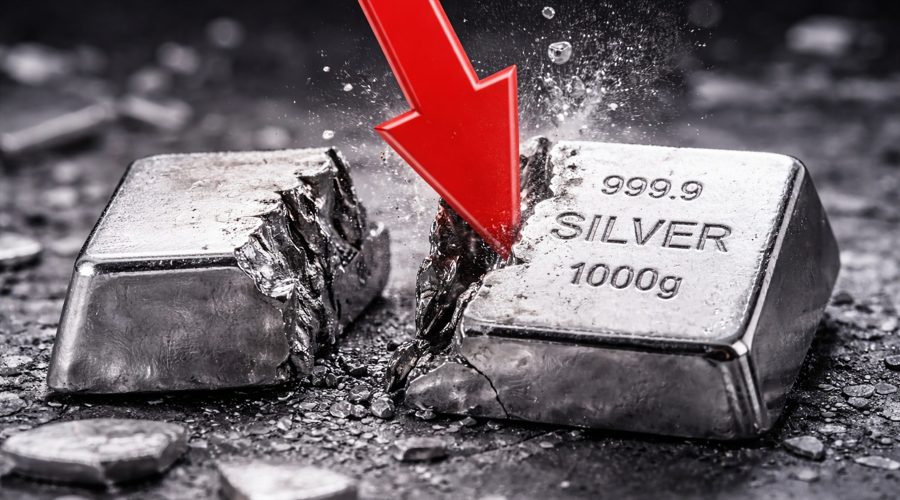
Silver is
trading at $64 per ounce on Wednesday, 10 June, 2026, the lowest price in three
months, as a confluence of macro headwinds and technical deterioration pushes
the white metal into what analysts now classify as a confirmed downtrend.
The
silver price is going down for the second straight week, shedding nearly 6% so far this
week alone after losing 10% the week before. For context, silver hit an
all-time high above $120 per ounce in late January, meaning the metal has shed
nearly half its value in less than five months.
The drop
mirrors a broader selloff in precious metals. Gold has been
falling since last week, trading below $4,200 per ounce Wednesday and deepening its own
three-month lows. The catalyst for both moves was a blowout US jobs report
released on June 6, which showed nonfarm payrolls rising 172,000 – more than
twice the 85,000 expected – according to the Bureau of Labor Statistics.
The
mechanics behind why the silver price is going down extend
well beyond one jobs report. Several forces have been compounding since early
2026:
|
Driver |
Impact on Silver |
|
Strong US |
Pushes |
|
Rising US |
Reduces |
|
Stronger US dollar |
Makes |
|
US-Iran |
Adds |
|
CME margin hikes (January 2026) |
Forced |
Bas
Kooijman, CEO and co-founder of DHF Capital, put it plainly: “Silver
prices stabilized to a certain extent after a decline last week. The metal
benefited from a retreat in the US dollar and bond yields following a decline
in oil prices and inflation fears to some extent.”
He added
that “the monetary policy backdrop continues to present challenges for
silver,” noting that a return to Middle East tensions “could lift oil
prices and bond yields and weigh on silver” – a scenario that appears to
be playing out precisely.
Contents
- 1 Silver Price Technical Analysis: The 200 EMA Break
- 2 The Consolidation Zone Is Gone
- 3 Silver Price Hi-Lo: Key Levels to Watch
- 4 How Low Can Silver Go? Fibonacci Extension Points to $30
- 5 What Would Reverse the Trend?
- 6 FAQ, Silver Price Analysis
- 7 Silver Price Technical Analysis: The 200 EMA Break
- 8 The Consolidation Zone Is Gone
- 9 Silver Price Hi-Lo: Key Levels to Watch
- 10 How Low Can Silver Go? Fibonacci Extension Points to $30
- 11 What Would Reverse the Trend?
- 12 FAQ, Silver Price Analysis
Silver Price Technical
Analysis: The 200 EMA Break
The most
consequential technical development this week is the break of the
200-day exponential moving average (200 EMA), a threshold widely regarded
as the dividing line between bull and bear regimes.
This is the
first time silver has traded beneath that level since mid-April 2025 – a
stretch of more than 13 months during which the metal rallied from around $30
to its January peak above $120, a gain of roughly 300%.
To put that The technical analysis of XAG/USD chart. Source: Tradingview.com
into perspective: in April 2025, the 200 EMA break proved short-lived, quickly
reversed as bulls defended the level. A similar brief test occurred around the
turn of 2025, when silver dipped below the average only to bounce. The last
sustained period below the 200 EMA before this week goes back to July 2023 –
nearly three years ago – which illustrates just how powerful and durable the
silver bull market was.
The break
is not merely a data point. It signals that the structural floor supporting the
rally has given way.
The Consolidation Zone Is
Gone
For most of
the period from early February through the end of May, silver had been
oscillating in a well-defined range, broadly between $67 and just below $89.
That zone
served as a consolidation base after the violent crash from the January
all-time high above $120 to below $60 in a matter of weeks, a selloff
triggered by a perfect storm of hawkish Fed news and forced liquidations.
This week’s
move below the 200 EMA has broken out of that consolidation zone entirely. When
multiple layers of support converge at the same price level – in this case the
200 EMA, the lower boundary of the February-to-May range, and prior structural
highs – traders call it a “confluence.” Breaking that
confluence now opens the chart to a fresh leg lower.
This is a
significant regime shift. Earlier this
year, the inverted head and shoulders pattern that had been forming suggested a
run back toward $120,
with May’s partial recovery toward $89 reviving that idea briefly. That
scenario is now off the table, with the trend officially flipping bearish.
Silver Price Hi-Lo: Key
Levels to Watch
Here is
where the XAGUSD hi-lo picture stands right now, and the
levels that will define price action in the weeks ahead:
|
Level |
Price |
Significance |
|
Current price |
$64 |
3-month low, below 200 EMA |
|
First support target |
$61 |
March |
|
Key structural support |
$55 |
October/November |
|
Bear target (primary) |
$46 |
Late |
|
Fibonacci extension target |
$30 |
100% of |
The $61
level will be the first test. That level represents the year-to-date low set in
March, and a failure there would shift attention toward $55 –
the zone carved by October and November 2025 highs, which now serve as major
structural support.
The primary
bear case places the downside target at approximately $46 per ounce,
corresponding to the late-October 2025 lows. From the current $64 level, that
represents a decline of roughly 28%. It is worth remembering that silver fell
from $121 to below $60 inside of weeks earlier this year, so moves of this
magnitude are not without precedent in this market.
How Low Can Silver Go? Fibonacci
Extension Points to $30
Applying
Fibonacci extension analysis to the current move offers a more extreme – though
not impossible – scenario. Using the decline from the January all-time high to
the March lows as the base leg, and then projecting from the subsequent
recovery that took silver back toward $89 in early May, the 100% Fibonacci
extension of that corrective structure falls just below $30 per ounce.
That level How low can silver go in 2026? Source: Tradingview.com
aligns with the April 2025 lows – the price level from which the entire rally
to $120 began. A return there would represent a 56% decline from
current prices and would essentially erase the entire historic silver rally of
2025-2026.
While that
is the outer boundary of the bear case rather than the base scenario, the
technical structure does not rule it out if key intermediate supports at $55
and $46 give way without resistance.
Previous
analyses from March 2026 had already flagged $55 as the key bear target, a level that is now the next major
stop on the chart if the current breakdown continues.
The industrial
demand argument has not disappeared. Silver’s use in solar panels, EV
components, and AI data center infrastructure remains a structural tailwind
that distinguishes it from gold.
How high
silver could go was a key discussion point just a few months ago, when $240 targets were being
floated. That conversation now takes a back seat to the question of where the
floor is.
For traders
accessing silver through CFD brokers, the heightened volatility cuts
both ways – OANDA Japan was forced to slash leverage and order sizes during
January’s record price swings, a reminder that extreme silver
volatility has direct consequences for broker risk management.
What Would Reverse the
Trend?
A sustained
bearish outlook is not guaranteed. Several catalysts could shift the picture:
- A US-Iran peace deal that reduces oil price
pressure, eases inflation fears, and gives the Fed room to hold or cut
rates - A dovish Fed pivot or weaker-than-expected
inflation data pulling rate-hike expectations back below 30% - A sharp US dollar reversal reducing the cost of
holding silver for international buyers - Industrial demand data showing supply deficits
tightening faster than macro headwinds can weaken the price
As Kooijman
noted, “any clear progress toward a diplomatic resolution in the Middle
East could help reduce the pressure on silver.” The metal’s dual nature –
part safe-haven, part industrial input – means the catalysts for a recovery
could come from either direction.
But until
one of those catalysts materializes, the chart suggests the path of least
resistance remains lower.
FAQ, Silver Price Analysis
Why is the silver price
falling today?
Silver is
falling because the metal broke below its 200-day exponential moving average
this week for the first time since April 2025. The trigger was a
stronger-than-expected US jobs report on June 6, which doubled market
expectations, pushed Federal Reserve rate-hike odds above 50%, lifted Treasury
yields, and strengthened the US dollar – all factors that raise the cost of
holding non-yielding assets like silver.
How low can silver go?
The primary
bear target from current levels of $64 is $46 per ounce – the late-October 2025
lows – representing a potential further decline of around 28%. A Fibonacci
extension analysis applied to the corrective structure from January’s all-time
high projects an outer target just below $30, which would mark a 56% decline
from current prices. The next key intermediate support before $46 is $55.
What is the silver price
prediction for 2026?
Institutional
forecasts remain wide. JPMorgan’s range of $60 to $90 for 2026 still
technically encompasses current levels, while some analysts surveyed by Yahoo
Finance expect a year-end price above $80. More aggressive bull cases from Bank
of America ($135-$309) assume a return to the structural bull market. The
technical picture, however, now points to the $46-$55 zone as the near-term
destination, with $30 as a tail-risk scenario if major supports break.
Is silver still a good
investment in 2026?
Silver
retains long-term structural support from industrial demand in solar, EV, and
data center applications. However, the near-term macro environment – rising
interest rates, a strong dollar, and elevated energy prices – is creating
significant headwinds. Any investor assessing silver should factor in the
broken technical structure and the possibility of continued price weakness
before the industrial demand thesis reasserts itself.
Silver is
trading at $64 per ounce on Wednesday, 10 June, 2026, the lowest price in three
months, as a confluence of macro headwinds and technical deterioration pushes
the white metal into what analysts now classify as a confirmed downtrend.
The
silver price is going down for the second straight week, shedding nearly 6% so far this
week alone after losing 10% the week before. For context, silver hit an
all-time high above $120 per ounce in late January, meaning the metal has shed
nearly half its value in less than five months.
The drop
mirrors a broader selloff in precious metals. Gold has been
falling since last week, trading below $4,200 per ounce Wednesday and deepening its own
three-month lows. The catalyst for both moves was a blowout US jobs report
released on June 6, which showed nonfarm payrolls rising 172,000 – more than
twice the 85,000 expected – according to the Bureau of Labor Statistics.
The
mechanics behind why the silver price is going down extend
well beyond one jobs report. Several forces have been compounding since early
2026:
|
Driver |
Impact on Silver |
|
Strong US |
Pushes |
|
Rising US |
Reduces |
|
Stronger US dollar |
Makes |
|
US-Iran |
Adds |
|
CME margin hikes (January 2026) |
Forced |
Bas
Kooijman, CEO and co-founder of DHF Capital, put it plainly: “Silver
prices stabilized to a certain extent after a decline last week. The metal
benefited from a retreat in the US dollar and bond yields following a decline
in oil prices and inflation fears to some extent.”
He added
that “the monetary policy backdrop continues to present challenges for
silver,” noting that a return to Middle East tensions “could lift oil
prices and bond yields and weigh on silver” – a scenario that appears to
be playing out precisely.
Silver Price Technical
Analysis: The 200 EMA Break
The most
consequential technical development this week is the break of the
200-day exponential moving average (200 EMA), a threshold widely regarded
as the dividing line between bull and bear regimes.
This is the
first time silver has traded beneath that level since mid-April 2025 – a
stretch of more than 13 months during which the metal rallied from around $30
to its January peak above $120, a gain of roughly 300%.
To put that The technical analysis of XAG/USD chart. Source: Tradingview.com
into perspective: in April 2025, the 200 EMA break proved short-lived, quickly
reversed as bulls defended the level. A similar brief test occurred around the
turn of 2025, when silver dipped below the average only to bounce. The last
sustained period below the 200 EMA before this week goes back to July 2023 –
nearly three years ago – which illustrates just how powerful and durable the
silver bull market was.
The break
is not merely a data point. It signals that the structural floor supporting the
rally has given way.
The Consolidation Zone Is
Gone
For most of
the period from early February through the end of May, silver had been
oscillating in a well-defined range, broadly between $67 and just below $89.
That zone
served as a consolidation base after the violent crash from the January
all-time high above $120 to below $60 in a matter of weeks, a selloff
triggered by a perfect storm of hawkish Fed news and forced liquidations.
This week’s
move below the 200 EMA has broken out of that consolidation zone entirely. When
multiple layers of support converge at the same price level – in this case the
200 EMA, the lower boundary of the February-to-May range, and prior structural
highs – traders call it a “confluence.” Breaking that
confluence now opens the chart to a fresh leg lower.
This is a
significant regime shift. Earlier this
year, the inverted head and shoulders pattern that had been forming suggested a
run back toward $120,
with May’s partial recovery toward $89 reviving that idea briefly. That
scenario is now off the table, with the trend officially flipping bearish.
Silver Price Hi-Lo: Key
Levels to Watch
Here is
where the XAGUSD hi-lo picture stands right now, and the
levels that will define price action in the weeks ahead:
|
Level |
Price |
Significance |
|
Current price |
$64 |
3-month low, below 200 EMA |
|
First support target |
$61 |
March |
|
Key structural support |
$55 |
October/November |
|
Bear target (primary) |
$46 |
Late |
|
Fibonacci extension target |
$30 |
100% of |
The $61
level will be the first test. That level represents the year-to-date low set in
March, and a failure there would shift attention toward $55 –
the zone carved by October and November 2025 highs, which now serve as major
structural support.
The primary
bear case places the downside target at approximately $46 per ounce,
corresponding to the late-October 2025 lows. From the current $64 level, that
represents a decline of roughly 28%. It is worth remembering that silver fell
from $121 to below $60 inside of weeks earlier this year, so moves of this
magnitude are not without precedent in this market.
How Low Can Silver Go? Fibonacci
Extension Points to $30
Applying
Fibonacci extension analysis to the current move offers a more extreme – though
not impossible – scenario. Using the decline from the January all-time high to
the March lows as the base leg, and then projecting from the subsequent
recovery that took silver back toward $89 in early May, the 100% Fibonacci
extension of that corrective structure falls just below $30 per ounce.
That level How low can silver go in 2026? Source: Tradingview.com
aligns with the April 2025 lows – the price level from which the entire rally
to $120 began. A return there would represent a 56% decline from
current prices and would essentially erase the entire historic silver rally of
2025-2026.
While that
is the outer boundary of the bear case rather than the base scenario, the
technical structure does not rule it out if key intermediate supports at $55
and $46 give way without resistance.
Previous
analyses from March 2026 had already flagged $55 as the key bear target, a level that is now the next major
stop on the chart if the current breakdown continues.
The industrial
demand argument has not disappeared. Silver’s use in solar panels, EV
components, and AI data center infrastructure remains a structural tailwind
that distinguishes it from gold.
How high
silver could go was a key discussion point just a few months ago, when $240 targets were being
floated. That conversation now takes a back seat to the question of where the
floor is.
For traders
accessing silver through CFD brokers, the heightened volatility cuts
both ways – OANDA Japan was forced to slash leverage and order sizes during
January’s record price swings, a reminder that extreme silver
volatility has direct consequences for broker risk management.
What Would Reverse the
Trend?
A sustained
bearish outlook is not guaranteed. Several catalysts could shift the picture:
- A US-Iran peace deal that reduces oil price
pressure, eases inflation fears, and gives the Fed room to hold or cut
rates - A dovish Fed pivot or weaker-than-expected
inflation data pulling rate-hike expectations back below 30% - A sharp US dollar reversal reducing the cost of
holding silver for international buyers - Industrial demand data showing supply deficits
tightening faster than macro headwinds can weaken the price
As Kooijman
noted, “any clear progress toward a diplomatic resolution in the Middle
East could help reduce the pressure on silver.” The metal’s dual nature –
part safe-haven, part industrial input – means the catalysts for a recovery
could come from either direction.
But until
one of those catalysts materializes, the chart suggests the path of least
resistance remains lower.
FAQ, Silver Price Analysis
Why is the silver price
falling today?
Silver is
falling because the metal broke below its 200-day exponential moving average
this week for the first time since April 2025. The trigger was a
stronger-than-expected US jobs report on June 6, which doubled market
expectations, pushed Federal Reserve rate-hike odds above 50%, lifted Treasury
yields, and strengthened the US dollar – all factors that raise the cost of
holding non-yielding assets like silver.
How low can silver go?
The primary
bear target from current levels of $64 is $46 per ounce – the late-October 2025
lows – representing a potential further decline of around 28%. A Fibonacci
extension analysis applied to the corrective structure from January’s all-time
high projects an outer target just below $30, which would mark a 56% decline
from current prices. The next key intermediate support before $46 is $55.
What is the silver price
prediction for 2026?
Institutional
forecasts remain wide. JPMorgan’s range of $60 to $90 for 2026 still
technically encompasses current levels, while some analysts surveyed by Yahoo
Finance expect a year-end price above $80. More aggressive bull cases from Bank
of America ($135-$309) assume a return to the structural bull market. The
technical picture, however, now points to the $46-$55 zone as the near-term
destination, with $30 as a tail-risk scenario if major supports break.
Is silver still a good
investment in 2026?
Silver
retains long-term structural support from industrial demand in solar, EV, and
data center applications. However, the near-term macro environment – rising
interest rates, a strong dollar, and elevated energy prices – is creating
significant headwinds. Any investor assessing silver should factor in the
broken technical structure and the possibility of continued price weakness
before the industrial demand thesis reasserts itself.
SOURCE LINK : Why Is Silver Going Down? Price Breaks 200 EMA