Our summary of recent economic events and what to expect in the weeks ahead.
Contents
Canadian Highlights
- Canadian GDP surprised to the upside in May, leaving Q2 on track for its strongest quarterly performance in two years.
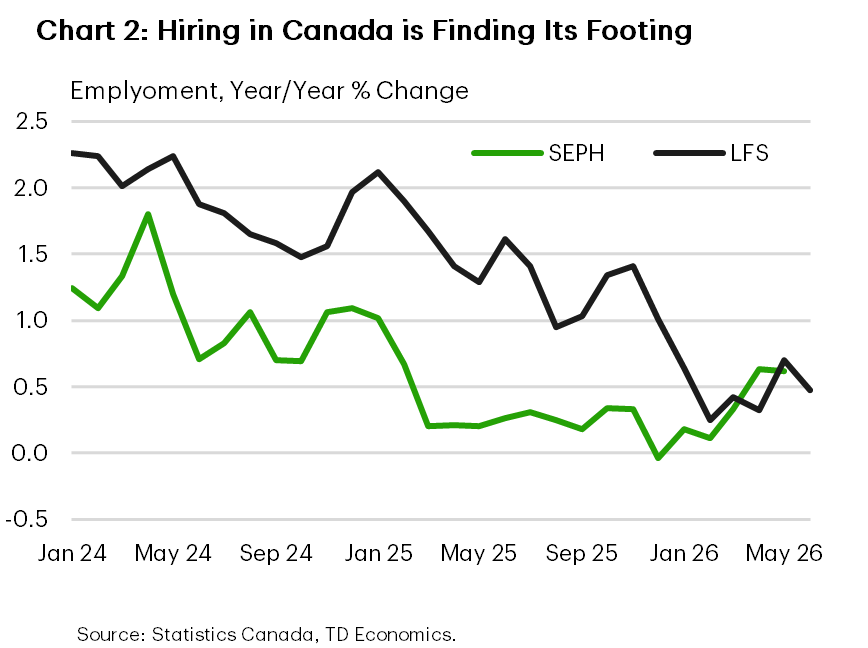
- Payroll employment posted a second consecutive monthly gain in May and reinforced signals that hiring conditions may be stabilizing.
- Despite firmer growth, we expect the Bank of Canada to remain in wait-and-see mode, holding the policy rate at 2.25% until year-end.
U.S. Highlights
- Financial markets were volatile as technology stocks came under pressure amid renewed scrutiny of AI spending, while elevated oil prices added to inflation concerns.
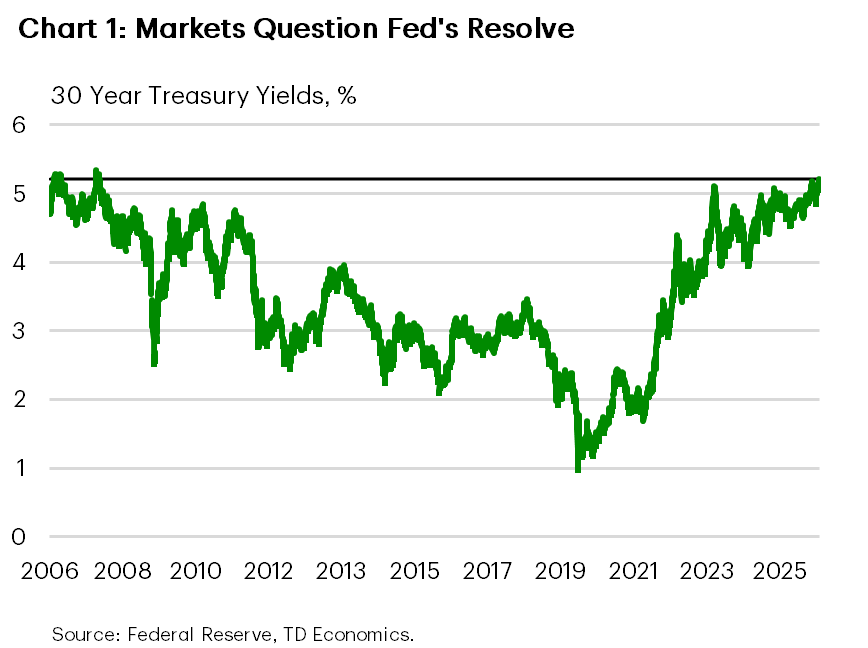
- The Fed held rates unchanged for a fifth consecutive meeting. Growing markets’ concerns about the Fed’s ability to lower inflation pushed 30-year Treasury yields to a 19-year high.
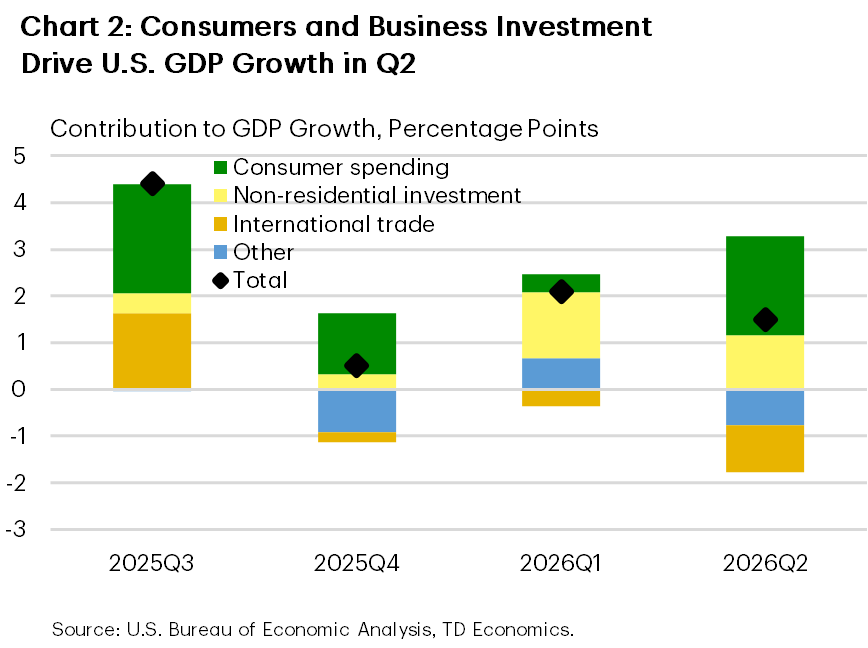
- Second-quarter GDP growth moderated, but a softer headline print masked stronger domestic demand as consumer spending rebounded and business investment remained strong.
Canada – Proof of Progress
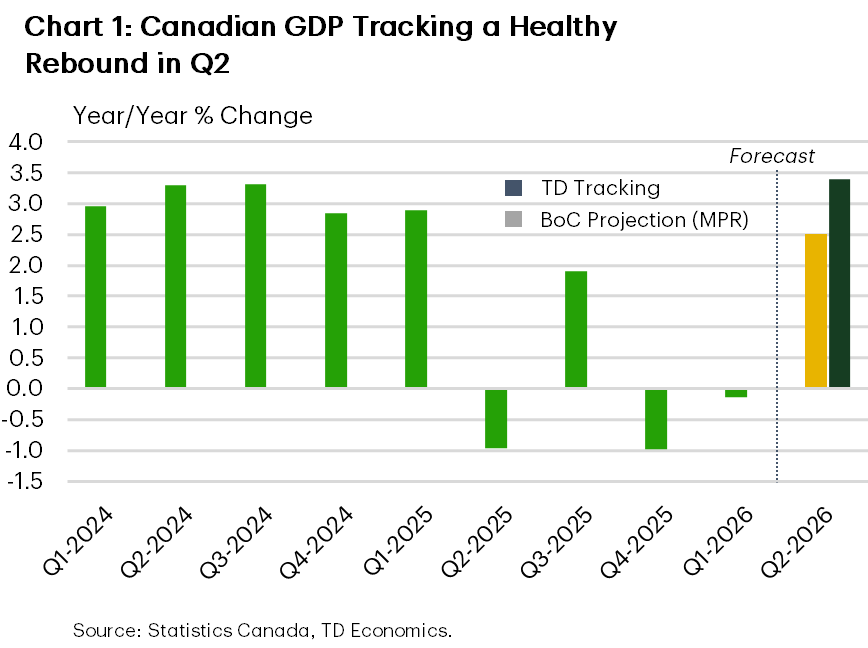
The Bank of Canada’s growing confidence in the economy was put to the test this week, and the latest GDP data delivered. Real GDP rose 0.3% m/m in May – handily beating expectations – while the advance estimate points to another 0.2% m/m gain in June. Under the hood, goods-producing industries helped drive the upside surprise, led by activity in construction and natural resources. Canada’s services side of the economy also chipped in, now having growth for four consecutive months. The latest gains across the economy have been broad-based, and importantly, trade-exposed sectors are showing tentative signs of recovery after a difficult start to the year. Taken together, second-quarter growth is tracking close to 3.5% annualized, well above the BoC’s latest projection (Chart 1). Should that materialize, it would mark Canada’s first three-handled quarterly growth rate since mid-2024.
The rebound is encouraging but should be kept in perspective. Even with a strong Q2, GDP growth in the first half of the year is tracking near 1.5% annualized, or roughly trend pace. Still, the data broadly validate the more constructive tone struck by policymakers earlier this month, who argued that the soft patch weighing on activity through late-2025 and early-2026 was beginning to fade. Excess supply remains and labour market conditions continue to show signs of slack, but the trend is improving. That improvement was also evident in this week’s Survey of Employment, Payrolls and Hours (SEPH) release, which showed a second consecutive 0.2% m/m gain in May payroll employment, reinforcing signals from the Labour Force Survey that hiring may be turning a corner (Chart 2).
Financial markets took the data largely in stride. Canadian two- and ten-year bond yields rose only a few basis points over the week, while the loonie gained roughly half a percent on firm oil prices and broad U.S. dollar weakness. Market pricing for a Bank of Canada hike edged modestly higher, but not enough to materially alter the outlook for rates. The muted reaction suggests investors view stronger growth as supportive, but not enough to change the policy outlook. Inflation remains the Bank’s primary source of uncertainty, with energy markets still vulnerable to renewed disruptions. Yet this week’s Summary of Deliberations from the last BoC rate decision offered little indication that policymakers are becoming more concerned about underlying inflation pressures. Instead, the Bank appears increasingly confident that the recent pickup in headline inflation remains largely an energy story.
That leaves monetary policy in a relatively comfortable position. Growth is proving resilient enough to rule out additional rate relief, while labour market slack, contained core inflation, and trade uncertainty continue to argue against a more restrictive stance. As such, this week’s developments remain consistent with our view that the Bank will stay on hold through the remainder of the year. Even so, the economy appears to have entered the second half of the year on firmer footing than expected.
Marc Ercolao, Economist
U.S. – Markets Issue a Yellow Card to the Fed
Financial markets had plenty to digest this week, with mega-cap tech earnings, the FOMC decision, and the second-quarter GDP. Equities swung sharply as investors weighed technology earnings against renewed scrutiny over AI-related capital spending and China’s progress in AI capabilities and semiconductor manufacturing. Still, stronger-than-expected results from several technology heavyweights helped revive the sentiment toward the end of the week. Oil prices also were in focus, with WTI crude easing relative to last week’s highs, but remained elevated at around US$85 per barrel Friday morning. Against that backdrop, investors have turned their attention to the Fed, where growing concern about inflation and rising doubts over the Committee’s willingness to do what is necessary to restore price stability pushed longer-term Treasury yields sharply higher.
The FOMC meeting was the week’s marquee event, though the main surprise was in the vote and not the policy announcement. Three officials dissented in favor of a 25-basis-point hike, highlighting growing concern within the Committee about inflation risks. The data support that concern. While inflation eased modestly in June, the improvement is unlikely to last if energy prices remain elevated. Core PCE inflation has remained above the Fed’s 2% target for more than five years, and the Fed is still searching for the back of the net. So even as Chair Warsh reiterated that the Committee would not “waver” in its commitment to restoring price stability, financial markets grew uneasy about the Fed’s willingness to raise rates to bring inflation back to target. 30-Year Treasury yields rose sharply following the meeting and remain near a 19-year high (Chart 1).
Despite the market jitters, the incoming data still point to an economy with solid underlying momentum. Real GDP growth slowed to a 1.5% annualized pace in the second quarter from 2.1% previously, but the softer headline largely reflected a surge in imports, with net trade subtracting roughly one percentage point from growth.
Under the hood, the economy’s engine was running considerably hotter than the headline GDP figure suggested, supported by a rebound in consumer spending and robust business investment (Chart 2). Consumer spending rebounded by a solid 3.2% annualized after a weather-affected first quarter. However, spending continued to outpace income, pushing the personal saving rate to its lowest level since mid-2022. With the boost from larger tax refunds fading, consumer resilience will increasingly depend on labor market strength and rising household wealth. Business investment also remained a bright spot. AI-related investment remained robust, but it was no longer the only game in town. Spending on industrial equipment surged 29% annualized in the second quarter, adding to evidence that the current capital spending cycle is becoming more broad-based.
Next week’s ISM surveys and the July employment report will shed further light on the balance of risks to prices and employment. For now, resilient domestic demand and persistent inflation pressures suggest the Fed’s inflation fight is entering overtime, with markets seeking reassurance that policymakers can credibly bring inflation back to target.
SOURCE LINK : The Weekly Bottom Line: Markets Issue a Yellow Card to the Fed