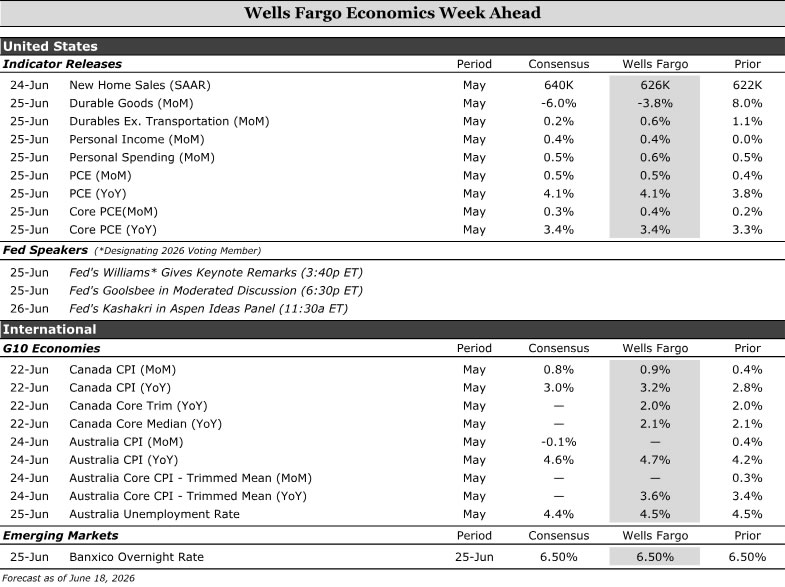
Consumer spending remains resilient, but underlying fundamentals continue to weaken. We expect nominal personal spending to rise at a solid pace in May, largely reflecting higher energy prices, with the PCE deflator accelerating and pushing year-over-year inflation back above 4%, leaving real consumption relatively subdued. At the same time, income dynamics remain soft, with real disposable income in negative territory and savings rates near historic lows, suggesting households are increasingly stretched even as Q2 consumption tracks a modest pace. In Canada, inflation is still being driven primarily by energy, and while we expect a firm headline CPI print, core measures should remain contained. In emerging markets, we expect Banxico to leave rates unchanged next week after policymakers indicated at the previous meeting that the easing cycle had likely concluded.
United States:
- Personal Income & Spending (Thursday)
G10 Economies:
Emerging Markets:
- Banxico Policy Rate (Thursday)
Contents
U.S. Week Ahead
Personal Income & Spending Thursday
Consumer resilience is holding for now, but underlying fundamentals continue to erode. Incoming data—like control group retail sales and higher-frequency card data—point to a solid nominal consumption backdrop in May. We look for personal spending to rise at a 0.6% clip in May, though most of that gain will merely reflect higher prices stemming from gasoline rather than a broad pickup in sales volumes.
We expect the PCE deflator to increase 0.5% during the month as well, leading the year-ago rate to surpass 4%, with the acceleration still largely driven by energy-related costs. In other words, nominal spending is firm, but real consumption remains far less impressive.
Remember it’s larger average tax refunds that have offset higher gasoline prices in recent months, but that tailwind is fading as refund flows slow. There may be a new near-term offset form World Cup-related spending—particularly at restaurants and related categories in broader PCE—in coming months, but that is unlikely to alter the broader trajectory amid weak consumer fundamentals.
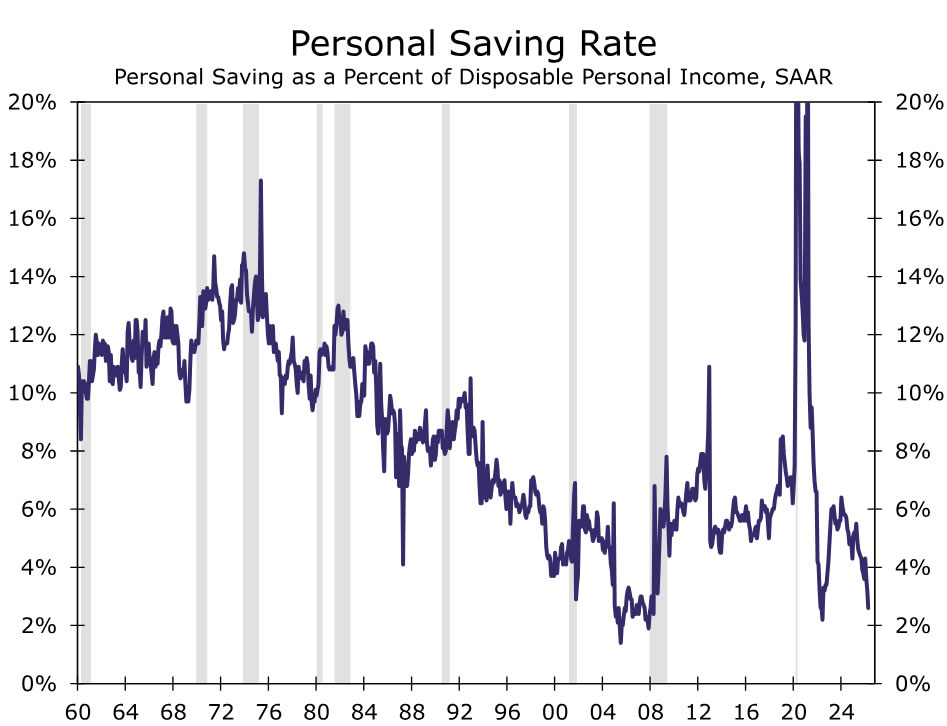
The underlying income backdrop is weak. Real disposable income excluding transfer payments has slipped into negative territory on a year-ago basis, while saving rates are bumping up against historic lows, signaling consumers are increasingly spending more of their income to sustain spending. We expect broad nominal personal income advanced 0.4% in May, but was negative when accounting for inflation. Spending should hold up in Q2; it’s on track to rise at a decent, yet unspectacular, ~2% annualized pace.
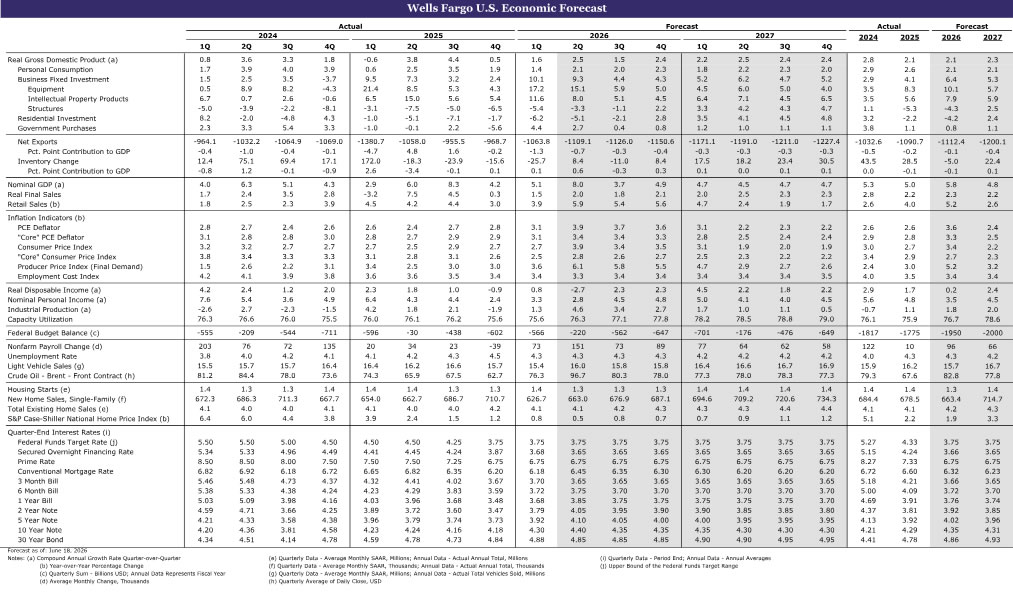
Updated Post-FOMC Meeting Forecast
G10 Week Ahead
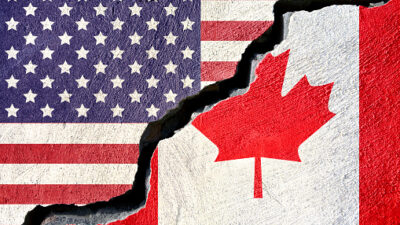
Canada Consumer Price Index (CPI) Monday
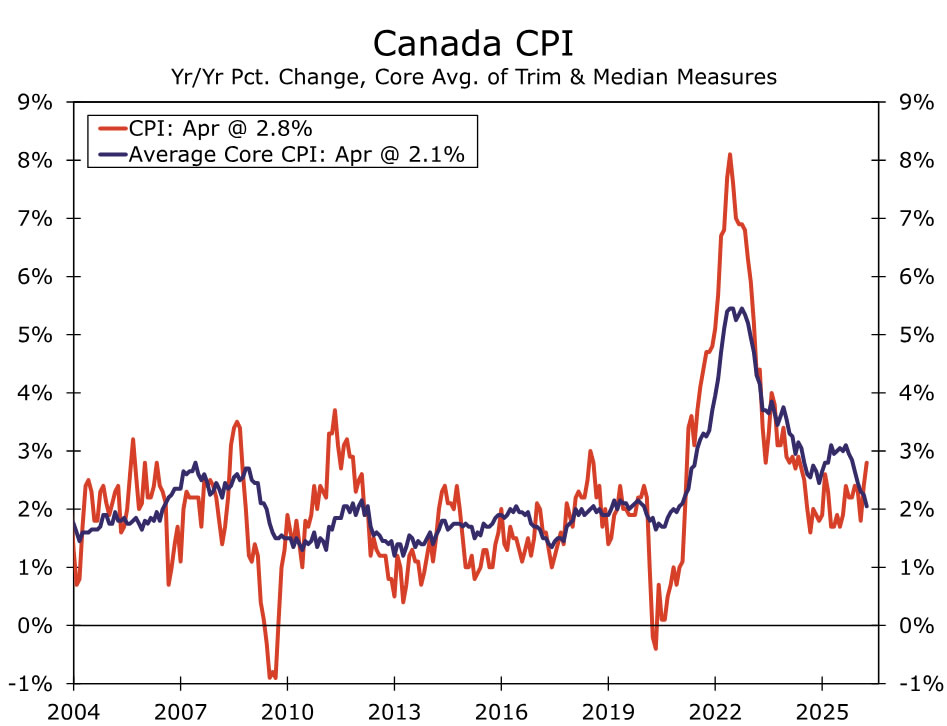
Consumer inflation remains energy-driven, with little evidence of broader price pressure building thus far. We look for headline CPI to rise 0.9% month-over-month in May, which would lift year-over-year inflation to 3.2%. But core measures are likely to hold near the previous month’s pace, with trimmed mean and weighted median inflation at 2.0% and 2.1%, respectively.
The composition matters. At its most recent monetary policy meeting, the Bank of Canada (BoC) signaled that it was willing to look through the current energy-driven inflation shock, absent clear evidence of broad-based pass-through to other consumer prices. This release is the last key inflation data ahead of the next mid-July BoC decision.
The broad outlook remains highly uncertain from the Middle East conflict to USMCA negotiations. From a monetary policy perspective, weaker activity and slowing wage growth could keep policymakers on hold for longer. While our baseline has been for two BoC rate hikes this year, if price pressures stay largely contained to energy and the U.S.–Iran interim peace deal holds, oil prices should gradually decline as supply improves. That would give the BoC greater scope to continue looking through the near-term energy shock and delay tightening, even in the face of a firm May print.
EM Week Ahead
Banxico Policy Rate Thursday
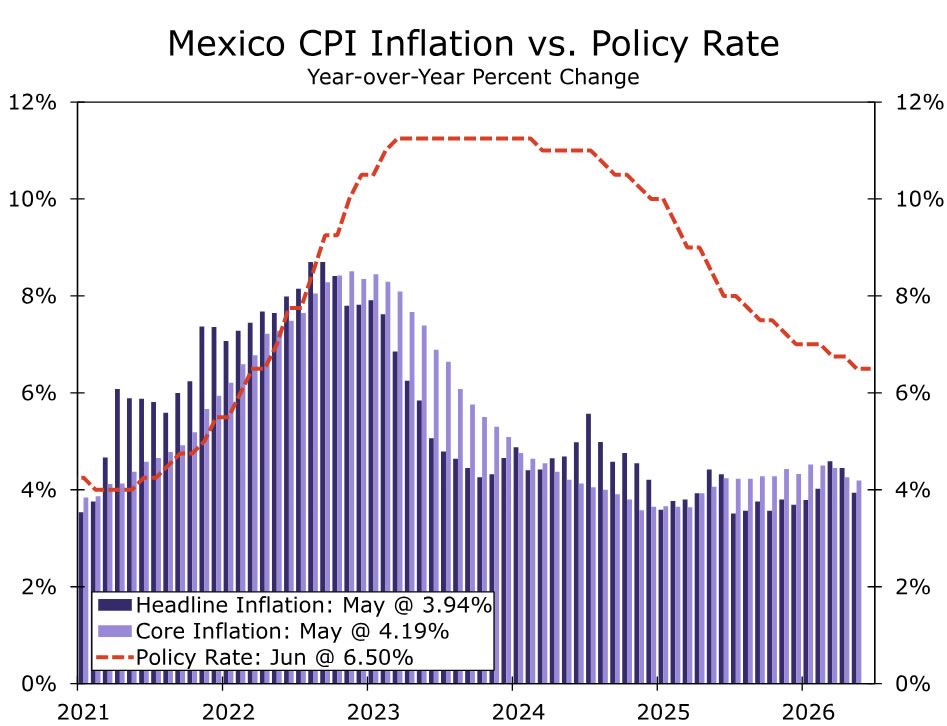
Next week, Mexico’s central bank, Banxico, will deliver its latest monetary policy decision, and we expect policymakers to keep the Overnight Rate unchanged at 6.50%.
At its previous meeting, Banxico cut rates by 25 bps and signaled that holding policy at current levels would likely be appropriate going forward, bringing the easing cycle that began in March 2024 to an end. Since then, the inflation backdrop has continued to improve. May headline inflation slowed to 3.9% year-over-year, while core inflation eased to 4.3%. Still, underlying inflation remains above target and price pressures have not fully disappeared. The growth backdrop also remains weak. Q1 GDP contracted 0.6% quarter-over-quarter, while year-over-year growth was barely positive at 0.2% (both modestly better than the initial estimates of -0.8% and 0.1%, respectively). Domestic demand remains soft, and restrictive financial conditions continue to weigh on activity. Recent business surveys also point to continued weakness in Q2, partly tied to uncertainty surrounding the Middle East conflict.
That said, some stabilization could emerge in the second half of the year if the current U.S.–Iran interim peace deal holds and external conditions improve. Additional support from World Cup-related activity could also help sentiment and demand. Against this backdrop, our view is that Banxico has likely reached a terminal rate of 6.50%, with risks favoring a prolonged pause rather than renewed cuts.
SOURCE LINK : Economics Week Ahead – ActionForex