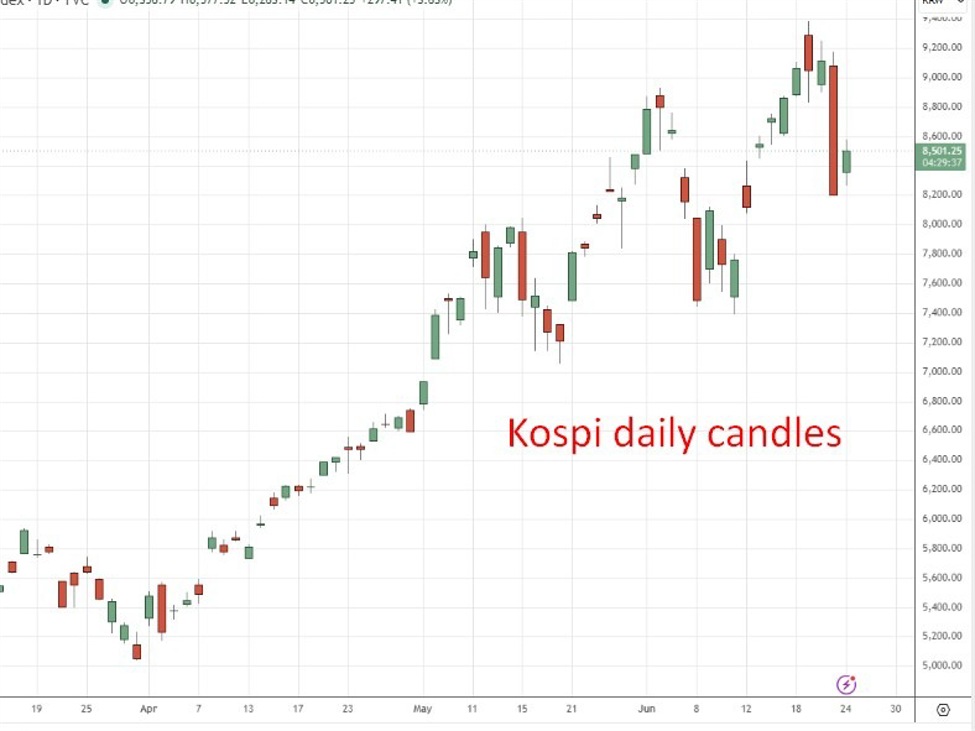
The combination of a near-$65 billion buyback and active government coordination with both Samsung and SK Hynix on accelerated chip facility construction is a rare double catalyst for Korean equities and explains the session bounce. The buyback, if confirmed, would rank among the largest single corporate capital return programmes in Asian market history and addresses a persistent discount that foreign investors have applied to Samsung relative to global semiconductor peers on governance and capital allocation grounds. The acceleration of new chip facility timelines by more than a decade, driven by AI demand, signals that both companies and the government view the current AI infrastructure build-out as a structural rather than cyclical opportunity. For global semiconductor supply chains, a second major Korean chip cluster coming online earlier than previously planned has implications for memory pricing, equipment demand and the competitive positioning of TSMC and other regional players. Citi’s earlier note flagging Korean equity positioning surging toward stretched extremes takes on added context here: the sharp move in Korean stocks today may have been partially anticipated by positioning data that was already signalling aggressive re-entry into the market.
—
Samsung Electronics is planning a 90 trillion won ($65bn) share buyback and South Korea is in talks with Samsung and SK Hynix on accelerating a new AI chip cluster by over a decade to 2034-35.
Summary:
- South Korea’s government is in active discussions with Samsung Electronics and SK Hynix on plans for a new large-scale semiconductor cluster, with a formal announcement described as imminent, according to a presidential policy adviser
- Presidential adviser Kim Yong-beom said AI-driven chip demand growth could require the two companies to accelerate ongoing facility construction by more than ten years, bringing the target timeline forward to 2034-2035, per the panel discussion
- Samsung Electronics is planning a share buyback programme worth 90 trillion won, equivalent to approximately $65 billion, according to a Yonhap News Agency report citing unidentified industry sources, with details expected to be announced shortly
- The buyback follows a wage agreement between Samsung management and its union under which approximately 10.5% of operating profit from the chip division will be set aside as special bonuses paid in stock, with the total cost estimated at 154 trillion won including tax, per Yonhap
- Employees receiving bonus shares will be able to sell one third immediately, with the remaining two thirds subject to one and two-year lock-up periods respectively, according to the report
- South Korea’s KOSPI has bounced in Wednesday trade, with the semiconductor sector leading gains on the confluence of the buyback report and government chip investment signals
South Korean equities staged a bit of a recovery on Wednesday as two major developments landed in close succession: a report that Samsung Electronics is planning a share buyback programme worth 90 trillion won, equivalent to approximately $65 billion, and confirmation that the government is in active talks with both Samsung and SK Hynix on accelerating a second large-scale semiconductor cluster by more than a decade.
The buyback report, carried by Yonhap News Agency citing unidentified industry sources, would represent one of the largest capital return programmes in Asian corporate history if confirmed. Samsung said it would announce details shortly. The programme follows a pay agreement reached last month between the company’s management and its union, under which approximately 10.5% of the chip division’s operating profit will be distributed as special bonuses to employees in the form of stock. The total cost of that commitment, including tax obligations running to 40% of the gross amount, is estimated at 154 trillion won. Employees will be able to sell one third of their bonus shares immediately on receipt, with the remaining portions subject to one-year and two-year lock-up periods.
The scale of the buyback, if it proceeds as reported, directly addresses one of the longest-standing criticisms of Samsung from foreign institutional investors: that the company has historically retained capital on its balance sheet rather than returning it to shareholders at a rate commensurate with its earnings power. A programme of this size would signal a structural shift in capital allocation philosophy and could narrow the discount that has persistently separated Samsung’s valuation from those of its global semiconductor peers.
The government dimension adds a strategic layer that goes beyond near-term market sentiment. Presidential policy adviser Kim Yong-beom told a panel discussion that explosive growth in AI-driven chip demand could require Samsung and SK Hynix to accelerate the construction of new facilities by more than ten years, bringing an ambitious new cluster online by 2034 to 2035 rather than in the mid-2040s as previously envisaged. Kim flagged that the challenge of identifying a site for a second major cluster was already a live policy question, with a formal announcement on plans described as imminent.
The framing from Seoul is unambiguous: South Korea views the global AI infrastructure build-out as a generational opportunity and intends to position its two dominant chipmakers at the centre of the supply response. For SK Hynix, which has emerged as a critical supplier of high-bandwidth memory to Nvidia and other AI accelerator manufacturers, the government’s backing for accelerated expansion reinforces a competitive position that is already drawing significant foreign investor interest. For Samsung, the combination of a massive capital return and state-backed expansion plans addresses both the valuation discount and the strategic growth narrative simultaneously, making Wednesday’s session bounce look less like a relief rally and more like a re-rating in progress.
SOURCE LINK : Samsung $65bn buyback and new chip cluster talks spark South Korea equity bounce