
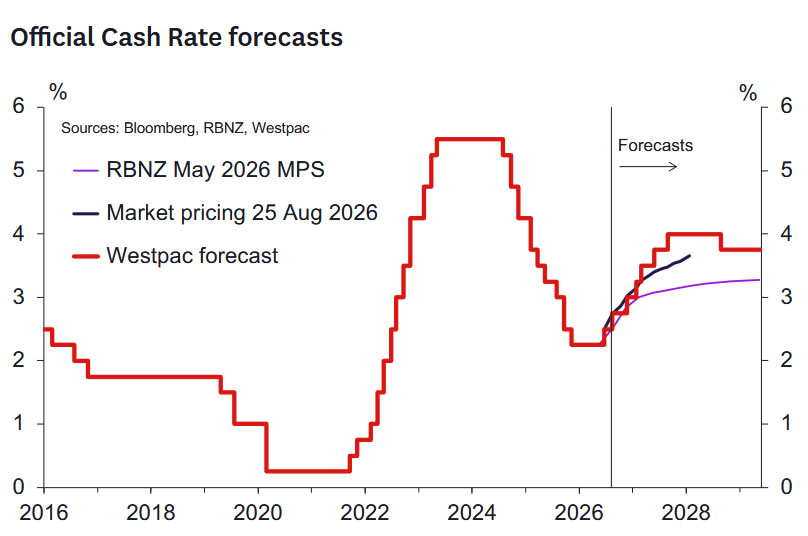
- We expect the RBNZ to raise the OCR by 25bp to 2.75% at its 2 September meeting. We see a consensus decision.
- The RBNZ’s projections are likely to imply a 3% OCR by year-end, the same as in the May MPS.
- Beyond 2026, we expect the OCR forecasts to also remain similar to the May MPS profile which implied the OCR peaking around 3.3%.
- Of interest will be any signalling the RBNZ offers about the likelihood of an OCR hike in October. We expect the RBNZ will signal that future moves are data dependent.
Contents
RBNZ Decision and Communication
We expect the RBNZ to follow through with another 25bp OCR increase to 2.75%. The decision seems likely to be reached by consensus.
We see the RBNZ being equivocal about the potential for an October OCR increase. They seem likely to adopt a data-dependent approach to determining whether to continue raising rates in October, given they will be close to the 3% neutral rate level the RBNZ often emphasises, and there is a lot of data due for release over September and October.
Data since the May projections were completed possibly imply a modest downward adjustment to the RBNZ’s OCR forecasts. Lower energy prices and inflation expectations seem to have that implication, although plenty of risks remain around those forecasts. Hence, it’s possible the RBNZ’s view won’t have shifted that much. We tend to think there won’t be much of a shift in the RBNZ’s OCR forecasts given the significant uncertainties at present.
Scenarios
A hawkish scenario is one where the RBNZ seems firmly resolved to continue to raise the OCR in October (and beyond). This might be signalled through a modest increase in the OCR forecasts from the terminal rate of 3.28%. If the RBNZ raised their neutral OCR assumption, then this would increase the chance of this scenario. Also, the MPC could imply that an OCR increase in October is more likely than not. Markets might then conclude increases are on the cards in both October and December, taking the OCR to 3.25% at year end.
A more dovish scenario is that the MPC might suggest that after 50bp of hikes it now has the luxury of taking some time to assess how the inflation outlook is evolving before raising the OCR further. Depending on the exact wording, this might bring into question whether an OCR increase might occur even in December. Less likely, more dovish market participants might even speculate that no further OCR increases may occur.
We don’t see either of these options as especially likely and would put perhaps a 10-15% probability on each.
Kelly’s Take
The strategy to return the OCR to around 3% by year-end seems clear and uncontroversial. It’s unclear that further increases will be required at every remaining meeting in 2026. The economic recovery remains fragile and significant risks abound. Care should be taken to not take the recovery for granted – especially while the improvement in the labour market remains embryonic.
Nonetheless core inflation remains too high, and I remain sceptical that inflationary supply shocks will dissipate either quickly or sustainably. Hence, it’s likely that higher interest rates will be required through 2027 once the economy is sustainably operating above trend and the labour market is recovering. A data-dependent approach is appropriate.
Appendix: Key Developments Since the May Monetary Policy Statement
Activity: The economy’s starting point remains close to the RBNZ’s May forecast. GDP rose 0.8% in the March quarter, slightly below the RBNZ’s 1.0% forecast, although historical revisions mean the level of activity was a little firmer than expected. June quarter growth is also likely to be close to the RBNZ’s flat forecast (we have pencilled in a 0.1% decline). As a result, the RBNZ’s estimate for the starting point output gap is unlikely to have changed materially from its May assumption of around -1.5%.
Labour market: Recent data have been mixed but continue to point to softness in the labour market. The unemployment rate rose to 5.6% in the June quarter, above the RBNZ’s 5.4% forecast. Employment growth was firmer than expected, though some of that strength likely reflected survey volatility. Wage growth was also a little firmer than expected but non-threatening, with the Labour Cost Index rising 0.7%qtr and 2.0%yr. Overall, these data are unlikely to have shifted the dial materially for the RBNZ. Updated estimates of net migration and population growth over the past year have been lower than expected.
Sentiment-based activity indicators: Understandably, surveys of the business sector have swung around in recent months. Looking across the latest QSBO, ANZBO and PMI results, overall business confidence is back around the levels seen before the Middle East conflict began. Businesses continue to report pressure on operating costs, and some hiring intentions gauges remain low. In the household sector, consumer confidence has also rebounded, although it remains low by historical standards. Given recent developments in the conflict, sentiment may weaken a little when the next ANZ business and consumer surveys are released just ahead of the RBNZ meeting.
Housing market: Housing market conditions have remained soft. Sales have fallen 5% since May, the average number of days to sell remains elevated and prices have edged down slightly. The RBNZ had already assumed a modest decline in prices over 2026 and limited gains over 2027, and significant changes to those assumptions appear unlikely.
Inflation: Inflation indicators have been volatile, reflecting recent large swings in global oil prices. While oil prices have picked up again in recent weeks and are elevated, they remain lower than assumed in the May MPS. The broader inflation picture does not appear more concerning than the RBNZ had anticipated. Headline inflation was 4.1% in the year to June, slightly below the 4.2% rise in the May MPS forecasts (but higher than the RBNZ’s updated 3.9% forecast at the July OCR review). Core inflation measures remained within the RBNZ’s target band in the June quarter, and there was little sign of widespread spillover from high oil prices into other areas. Non-tradables inflation also eased to 3.4% in the June quarter, in line with expectations. But businesses’ operating costs remain under pressure, with large numbers of firms continue to report rising costs and plans to increase prices.
Inflation expectations: Surveys of households, businesses and professional forecasters all recorded declines in inflation expectations in the September quarter. In most cases, expectations have returned to the levels seen before the oil price spike. That will be encouraging news for the RBNZ given the risk of a step higher following the recent rise in headline inflation and the continued firmness in oil prices.
Trade: Prices for New Zealand’s commodity exports have remained firm, and merchandise export volumes are on track to grow by more than 2% this year. Services exports, particularly tourism, have also strengthened and are expected to grow by around 8% this year. Although oil prices remain elevated, the terms of trade are still likely to be around 4% higher than the RBNZ expected through the latter part of this year.
Financial conditions: Domestic financial conditions have mostly tightened since the RBNZ’s May meeting. Notably, one- and two-year fixed mortgage rates have risen by around 35bps since May, compounding the increase seen since the start of the year. As a result, the easing in borrowing costs seen over recent years as households rolled off earlier high mortgage rates has now come to a close. The NZ dollar TWI is currently sitting at 67.2, above the 66.6 level assumed in the RBNZ’s May projections.
SOURCE LINK : Preview of RBNZ September 2026 Monetary Policy Statement: Removing a Little Bit of Stimulus